Prime minister, Navy clash over submarine name

The ROKS Hong Beom-do cruises in this Jan. 19, 2018, file photo. Courtesy of Defense Acquisition Program Administration
Controversy surrounding freedom fighter Hong Beom-do becomes source of naming dispute
By Nam Hyun-woo
Prime Minister Han Duck-soo, the defense ministry and the military are clashing over the name of a 1,800-ton Navy submarine which was named after an independence fighter.
The prime minister seeks to rename the ROKS Hong Beom-do citing the freedom fighter's involvement with the Soviet Communist Party. The Navy and the Ministry of National Defense have stated that they have no plans to rename the submarine, citing naval tradition and the absence of a precedent on the international stage.
However, Han is pushing for the name change, apparently in line with President Yoon Suk Yeol's campaign of consolidating a right-wing ideology as the norm in the country.
During a press briefing, Friday, an official at the Ministry of National Defense clarified that the Navy is not considering another name for the submarine following the prime minister's remarks on Thursday.
“The prime minister was responding to a lawmaker's question, and it seems that he was referring to the necessity of a new name,” the official said. “However, the Navy is not considering it. As far as I know, the prime minister's remarks are in line with the defense ministry's earlier position that it will review the possibility if necessary. But there seems to be no order from the prime minister's office.”
During a National Assembly session, Thursday, Han said, “I believe we should consider renaming the submarine, as it is named after Hong, who had a record of joining the Soviet Communist Party.”
The ROKS Hong Beom-do was launched in 2016 as the seventh Sohn Won-yil class submarine. The Navy named the vessel after the independence fighter to “honor his patriotic spirit and promote public awareness of national security.”
Along with the vessel, other Sohn Won-yil class submarines are named after those who fought for the country's independence from the 1910-1945 Japanese colonial annexation, including Kim Jwa-jin, Yun Bong-gil and Lee Beom-seok.
Hong became the subject of heated debate after the defense ministry's revealed a plan to remove his bust from the military academy. The academy announced, Thursday, that it decided to relocate the bust “to a place outside the academy where his contribution to independence can be visible.”
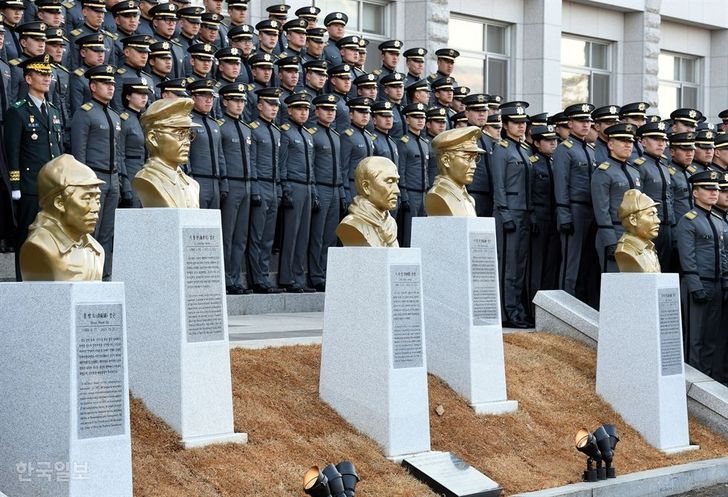
This file photo taken March 1, 2018, shows the busts of independence fighters, including General Hong Beom-do, left, at the Korea Military Academy in northern Seoul. Korea Times file
The Navy is apparently refusing to rename the vessel, because it is a decision that is finalized by the chief of Naval Operations. With Army generals comprising of the defense ministry's core, Navy officials do not want to become mired in controversy related to Hong, which was triggered by the defense ministry.
Another reason is that there are not many cases of a naval vessel having its name changed. While changing a ship's name is historically avoided in the nautical world ― as a matter of superstition ― Korea has only two previous cases of renaming its naval warships: ROKS Iri which was renamed to ROKS Iksan and ROKS Geumhwa to ROKS Gimhwa, because they were both named after cities whose names were changed after the vessels were christened.
Internationally known cases include the Soviet cruiser Slava, which was renamed to Moskva as it was recommissioned into the Russian Navy.
The attempt to rename the submarine is in line with Yoon's recent campaign against “anti-state totalitarian communist forces.” Following his Liberation Day speech on Aug. 15, in which he urged the public not to be deceived by such forces, Yoon has become more visibly critical of communist and leftist ideas.
The efforts, however, appear to be backfiring at the moment. According to an Aug. 29-31 Gallup Korea survey, Yoon's job approval rating stood at 33 percent, down 1 percentage point from a week earlier.
The poll showed that 21 percent of Yoon's critics picked the issue of Japan's release of wastewater from the Fukushima Daiichi Nuclear Power Plant as the reason for their skepticism, while the ideological controversy emerged as a new reason, accounting for 2 percent.
The poll surveyed 1,002 adults, and further details are available on the National Election Survey Deliberation Commission's website.