Government's overdrawn account adds to concerns over tax shortfall

Deputy Prime Minister and Minister of Economy and Finance Choo Kyung-ho, right, speaks before the press on the tax code revision at Government Complex Seoul, July 24. Yonhap
Experts warn that tightened monetary policy is still necessary despite government's borrowing
By Yi Whan-woo
The government has borrowed more than 100 trillion won ($74.5 billion) from the central bank so far this year, adding to concerns over shortfalls in tax revenue.
The borrowing was available in the form of an overdraft, a pre-arranged amount of cash drawn from a bank account for a short term when the bank balance drops below zero.
Experts warn that such overdrawn accounts can also hinder the country's fight against inflation which it managed to bring down to a 25-month-low of 2.3 percent in July.
They noted that the government's borrowing could send the wrong signal to the market that tightening liquidity may no longer be necessary, at a time when the nation's household debt burden is rising at the second fastest rate in the world.
“You should not think of the government borrowing money from the central bank and paying it back as simply taking out money from your left pocket and putting it into your right,” said Kwon Oh-in, a director at Seoul-based activist group Citizens' Coalition for Economic Justice. “The borrowing indicates that the government is failing in managing budget under its eased tax regulation.”
“The borrowing can certainly result in excessive outflow of cash into the market as it happens over and over,” he said.
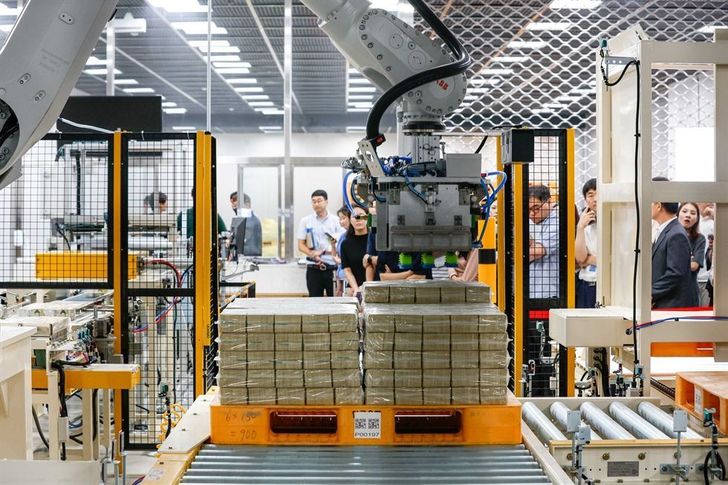
A robotic arm handles stacks of banknotes as a part of the newly-introduced automated safe deposit system at the Bank of Korea (BOK) headquarters in central Seoul, Aug. 16. Joint Press Corps
Kwon referred to the Ministry of Economy and Finance taking out 100.8 trillion won from the Bank of Korea (BOK) in the first seven months of 2023.
The ministry also paid 114 billion won in interest through to the end of June.
The figures were released by Rep. Yang Kyung-sook, a main opposition Democratic Party of Korea (DPK) lawmaker and also a member of the National Assembly's Strategy and Finance Committee, based on BOK data she obtained.
According to the data, the ministry took out cash within the overdraft limit of 50 trillion won, while paying principal and interest whenever available to ensure it can continue to borrow. Repayment is complete and the outstanding balance currently remains at zero.
But even so, the overdrawn account prompted concerns over shortages in tax revenue, as 100.8 trillion won was the largest such withdrawal since 2010 when the relevant data was compiled electronically for easier access and comparison with the past.
The subsequent 114 billion won in interest was also the largest amount of interest incurred since 2010.
“The record amount of borrowing indicates the government can't collect tax that is sufficient enough to meet its yearly target, and in that regard, the tax policy should be revised,” said an economist at People's Solidarity for Participatory Democracy (PSPD), also an activist group, on condition of anonymity.
According to the finance ministry, tax revenue in Korea totaled 178.5 trillion won in the half of 2023, down 39.7 trillion from a year earlier.
The tax collected so far this year only accounts for 44.6 percent of the government's yearly target of 400.5 trillion won.
The shortage in tax revenue comes as the government has been lessening the tax burden for businesses in order to spur corporate investment under its market-driven economic vision.
“Under the circumstances, I would strongly urge the government to draw up a supplementary budget,” the PSPD economist said.
Regarding inflation, he assessed that the government's use of the overdraft could be perceived as signifying that inflation is over and that individuals may excessively take out money from banks amid snowballing household debt.
Inflation softened to a 25-month-low of 2.3 percent in July, after the BOK carried out an aggressive monetary tightening campaign for nearly a year and a half through January and hiked the benchmark interest rate by 3 percentage points to 3.5 percent.
The 3.5 percent rate marks the highest in more than 10 years. It remains unchanged since January.
In the meantime, household borrowings from banks amounted to 1,068 trillion won as of July, up 6 trillion won from a month earlier, according to the BOK.
The July figure also marked the fourth consecutive monthly increase, as demand grew for mortgage loans amid the central bank's rate freeze.
Correspondingly, data from Bank for Intentional Settlements (BIS) showed the total debt service ratio (DSR) in Korea was 13.6 percent in 2022, second only to Australia's 14.7 percent.
DSR measures how much a borrower has to pay for principal debt and interest relative to yearly income. The higher DSR, the more a borrower will need to spend his or her income to pay off the debt.