What's behind Korea's relatively low inflation amid global surge?

A vendor organizes market stalls at a traditional market in northwestern Seoul's Seodaemun District, Tuesday. Yonhap
Consumer price rises eased to a 25-month low in July
By Lee Yeon-woo
Korea's consumer prices rose by 2.3 percent in July, easing to a 25-month low. Given that major economies are still facing continuous price increases, Korea's low rate of inflation stands out as an exception. Market watchers believe that the government's indirect intervention in private sector prices explains this difference.
Korea's inflation rate has been slowing down, recording 4.8 percent in February, 4.2 percent in March, 3.7 percent in April, 3.3 percent in May and 2.7 percent in June.
This is in stark contrast to other nations still grappling with high inflation. As of June, Korea's inflation was the fifth-lowest among the 38 OECD member countries. The only countries that had lower rates than Korea were Denmark, Greece, Spain and Switzerland.
“Along with policy authorities' efforts to stabilize prices, households and corporations have shared the burden, refraining from excessive increases in wages or product prices. For this reason, Korea experienced somewhat lower inflationary pressures last year compared to other major countries,” the research department of the Bank of Korea (BOK) noted in a recent commentary released on its website.
This year, the government has been hosting frequent meetings with the food industry, asking it to curb price surges. After Finance Minister Choo Kyung-ho specifically asked instant noodle makers to drop prices, citing low wheat prices, the industry simultaneously lowered prices in June.
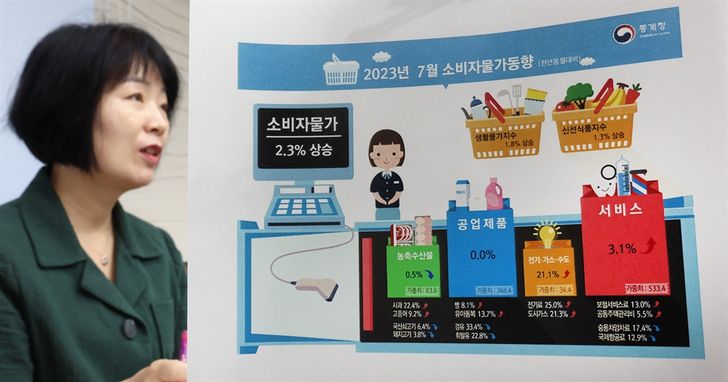
Kim Bo-kyung, a senior official at Statistics Korea, announces consumer price trends for July during a media briefing at Sejong Government Complex, Wednesday. Yonhap
Additionally, the government is keeping a lid on the drastic surge in energy prices by shouldering the financial burden of Korea Electric Power Corp. (KEPCO) and Korea Gas Corp (KOGAS). These state-run energy firms are facing mounting debts due to rising costs.
These factors were pointed out as the difference with other nations, particularly European ones, where “greedflation” is largely blamed for price surges. The term refers to companies raising prices to take advantage of inflation to boost their profit margins. Some corporations were accused of excessive price increases due to the pressure of increased manufacturing costs amid Russia's invasion of Ukraine.
The BOK stated that Korea has not experienced this phenomenon thanks to its distance from the Ukraine war and a lesser reliance on the resulting global supply chain disruptions.
However, the trend of slowing inflation is expected to face a turning point in August. The base effect from last year's high inflation will likely dissipate, and the impact of damage from heavy rainfall is also expected to be significant. There remains a possibility of further utility rate hikes to improve KEPCO's financial solvency.
“The price trend may become volatile for a moment in August and September, and is expected to decline again starting from October,” said Jang Bo-hyun, a senior official at Statistics Korea. “We will respond in a timely manner while monitoring the trends of price and supply for each item to maintain price stabilization.”