Kunsan National University seeks to attract global talent for local firms

Kunsan National University President Lee Jang-ho / Courtesy of Kunsan National University
'Foreign students can be given benefits in terms of visa issuance'
By Jun Ji-hye
Kunsan National University, located in North Jeolla Province, has established a strategy aimed at attracting more foreign students to nurture global talent to work at businesses and factories located in the Gunsan and Saemangeum industrial complexes nearby, according to its President Lee Jang-ho.
As part of efforts to achieve that goal, the university signed memoranda of understanding with about 150 schools around the world, including Pueblo Community College in Colorado as well as ones in China, Japan, India and Vietnam.
The university's strategy coincides with an announcement made earlier this month by the Ministry of Education to attract 300,000 foreign students to study at domestic universities by 2027 in a bid to?preemptively?secure skilled foreign workers for?high-tech?industries and boost the global competitiveness of the country.
“There are various options for foreign students. They can enter Kunsan National University as a freshman, transfer as a third-year student or enter our graduate school,” Lee said during a recent interview with The Korea Times.
“Undergraduates are offered an opportunity to gain work experience at local companies in addition to their studies at school. Those admitted to the graduate school can participate in university-industry collaboration in research and development (R&D). Through these admissions schemes, we aim to nurture global talent to drive the future of the regional economy,” he added.
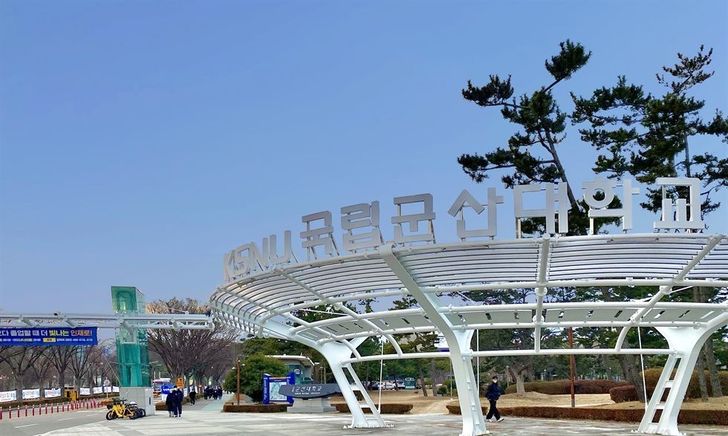
Main entrance of Kunsan National University / Courtesy of Kunsan National University
Lee noted that foreign students can be given benefits in terms of visa issuance. A trial program being carried out in the Gunsan region enables their student visas to be easily converted into a work permit right after they are employed by local companies. This trial program is supported by the Ministry of Justice, he added.
“Foreign students studying here can enjoy many benefits regarding employment and visa issuance,” Lee said. “I will continue to establish systems and platforms and improve existing ones to supply global talent to local companies at the earliest possible date.”
According to Lee, the Saemangeum industry complex specializes in secondary batteries, while the Gunsan industrial complex is dedicated to developing and producing parts and materials for electric vehicles. Combining these two industrial complexes, the region aims to become a mecca for producing autonomous electric vehicles in the country.
“We have already built a cooperative system with companies in those complexes,” Lee said. “We have carried out a variety of R&D programs with them after receiving support from various institutions such as the Ministry of Trade, Industry and Energy, the Ministry of Oceans and Fisheries and the Ministry of Environment.”
In a bid to nurture talent for those industrial complexes, the university created the Department of Energy Science and Engineering that will accept students beginning next year.
The new department offers education in four areas ― secondary batteries, hydrogen energy, small modular reactors and renewable energy.
“This department will contribute to developing the specialized industry and relevant research system in the region,” Lee said.
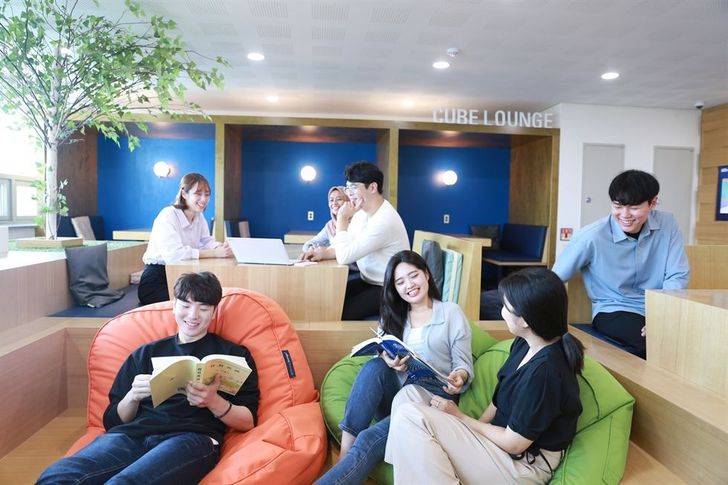
Students spend time at Kunsan National University's campus in this undated photo. Courtesy of Kunsan National University
Challenges
When Lee took office in May last year, the university had some financial problems due to a reduction in the number of students. This led him to focus on ways to overcome the financial difficulties and attract more new students.
He has tried to curtail expenses in management and merge several departments after analyzing data accumulated over the past two years.
“The data analysis found a major mismatch between departments offered by the university and what students want to learn,” Lee said. “So, we made an index showing the number of students who want to study at certain departments, and adjusted the quota of each department based on that index.”
This process created a large department teaching software technology to 180 students.
“By expanding that department, we aim to cultivate around 10,000 talented workers in future industries such as artificial intelligence and autonomous driving over the next 20 years in time for the Fourth Industrial Revolution,” Lee said.
Efforts to reflect the needs of students have resulted in an increase in the number of new enrollments this year. The university managed to fill 95.6 percent of its entire quota.
“Now, we have a sound financial structure and can provide a wide variety of support for students studying here,” Lee said, noting that the university's scholarship program is the most comprehensive in the region.
According to the university, some 2.7 million won ($2,000) has been awarded as a scholarship to each student annually. This amount accounts for about 70 percent of the college tuition that stood at 3.9 million won on average this year.
The university also plans to expand the beneficiaries of its school buses that were available to freshmen in North Jeolla Province.
“From this fall semester, all students can use the school buses. This will increase accessibility to the school,” Lee said.
He added that the university is constructing a new dormitory, which can accommodate about 1,700 students. New students entering the school next year will be given first priority to move in.
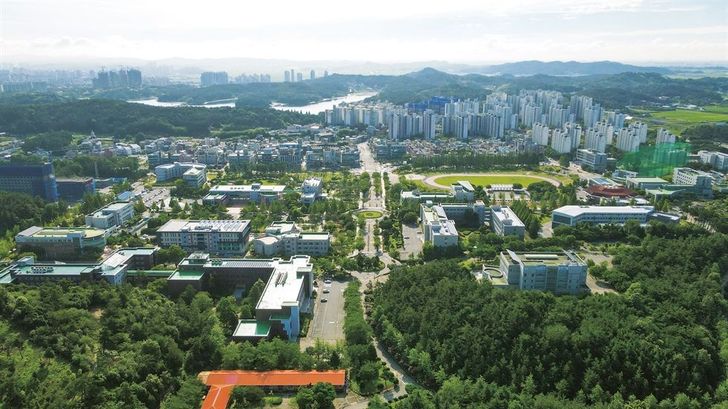
A bird's-eye view of Kunsan National University. Courtesy of Kunsan National University
In a bid to promote social contribution to grow together with the local community, the university fully opens its key establishments, including sports facilities, restaurants, libraries and seminar rooms, to local residents.
It has installed sufficient lighting and surveillance cameras on campus to enhance the level of safety.
“To support local artists, we open the university-owned galleries or museums to them and help their fundraising by connecting them with local companies,” Lee said.
“We also offer necessary resources for young people seeking to start a new company and join efforts to preserve cultural assets in the region,” he added.