Italian embassy offers insight into future of metaverse

Italian Ambassador to Korea Federico Failla delivers a speech during the "Ethics in Metaverse" symposium at the National Assembly in Yeouido, Seoul, July 3. Courtesy of Embassy of Italy in Korea
By Kwon Mee-yoo
The Embassy of Italy hosted two international symposiums on the metaverse, exploring the societal effects of the emerging technology and discussing ways to navigate related challenges, July 3 and 4.
The first symposium, held in collaboration with the National Assembly Forum on New Industry and the Korea-Italy Parliamentary Friendship Group, charted an ethical vision of the metaverse, while the second one, held with Ministry of Science and ICT, focused on the future of the metaverse from a humanistic perspective.
"Artificial intelligence, augmented reality, cloud computing, non-fungible tokens: all signs that we are already entering and living in the metaverse. The creation of a new reality, where human beings will coexist and interact with each other, will constitute a great change for our vision of the world. And, as always, changes creates uncertainty. In order to confine such uncertainty, change must be managed," Italian Ambassador to Korea Federico Failla said during the "Ethics in Metaverse" symposium at the National Assembly, July 3.
"Our approach must go beyond borders, since the metaverse itself does not have borders. In this regard, cooperation between Italy and South Korea seems natural since they are the two countries that share a set of values such as human rights, freedom, democracy, rule of law, anti-discrimination and gender equality, which makes it easier to find common and shared ethical insights for the new world to come."
Two Italian experts ― Paul Benanti, professor of moral theology, bioethics, neuroethics and ethics of technologies at Pontifical Gregorian University in Rome, and Tiziana Catarci, professor of computer science at La Sapienza University in Rome ― flew to Seoul to attend the symposiums.
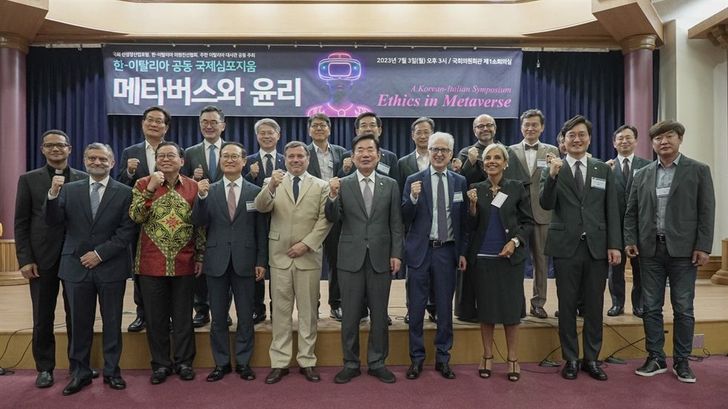
Participants of the "Ethics in Metaverse" symposium pose at the National Assembly in Yeouido, Seoul, July 3. Courtesy of Embassy of Italy in Korea
Benanti is a Franciscan monk and engineer-turned-theology professor who also serves as adviser to Pope Francis on matters of artificial intelligence and technology ethics. He emphasized that the metaverse could evolve into the reality of the future, but warned the absence of an ethical framework for this emerging "reality" could push society toward an unsustainable path.
In addressing the increasingly blurred lines between humans and machines and the ethical implications of the metaverse, Benanti questioned the relationship between humans and technology.
"If human being and machine are on the same level, how can we know whether the human being is the sensor for the machine or the machine could become the sensor for the human being?” he asked. “Translated into the experience of every day, is our finger on the smartphone that make the sensor for the smartphone or is the smartphone with notification the sensor for us to change our behavior?"
Benanti noted that metaverse ethics will most likely be "ethics by algorithm," which refers to data such as user behavior being stored and learned by algorithms, so humans need to set ethical principles now, in the early days of the metaverse, to ensure that positive data is accumulated by algorithms.
"Ethics is the long journey of human beings on the Earth. Now it's time to write another chapter of that journey. Still, up to now, (it is ethics of) human beings, but this kind of ethics has to be computed also by machine. So the new chapter of ethics that we develop is that we fuse inside the system to keep humans in the center," he said.
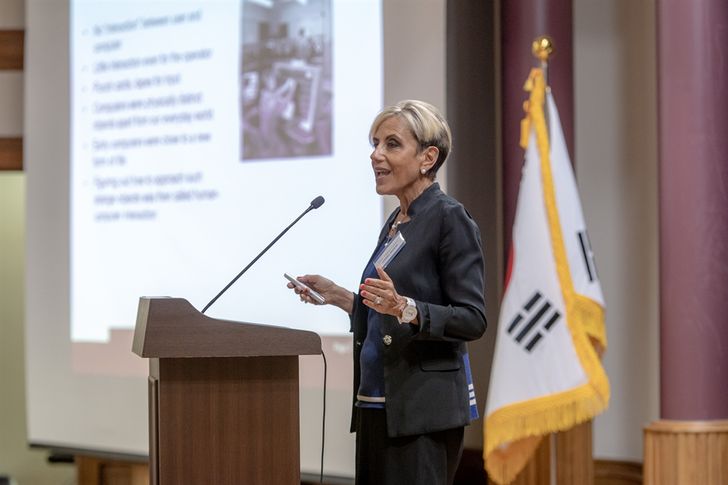
Tiziana Catarci, professor of computer science at La Sapienza University in Rome, speaks during the "Ethics in Metaverse" symposium at the National Assembly in Yeouido, Seoul, July 3. Courtesy of Embassy of Italy in Korea
Catarci described the metaverse as a sphere where the tangible and the virtual merge, forming a physical entity.
She noted that it is crucial to ensure avatars within the metaverse act voluntarily in accordance with the same ethical principles as in the real world and trusted interactions make the metaverse a more diverse, fairer place.
"The metaverse should borrow the same ethical rules of the real world. So, avatars should be behaving in the metaverse just as like people that comply and in alignment with the moral principles of the real world human beings," Catarci said.
"The metaverse could be a new frontier for a better world where humans are the owners of a total open world... There are possibilities there are risks. So it's up to us to do implement and the possibilities and to our best to limit the risks."