COVID changes landscape of content industry

OTT, online concerts established as major tools to enjoy content
By Lee Gyu-lee
For the past two years, the COVID-19 pandemic has impacted many sectors around the world, stagnating economies with unprecedented disruptions that changed people's lives in various ways.
The media industry was no exception. Measures taken by governments and health authorities to battle the spread of the virus, like social distancing and travel restrictions, limited people from going to movie theaters, K-pop stars from traveling abroad for events, and production studios from filming series or movies.
Amid the struggle, the industry found new ways to work around the obstacles, experiencing changes in the way people consume media content, which led to the rise of over-the-top (OTT) platforms and the use of new technology for virtual content like concerts.
According to a report by consulting and accounting firm, PricewaterhouseCoopers, global cinema revenue plummeted from $45.2 billion in 2019 to $12.7 billion in 2020. It bounced up to $22.8 billion in 2021, but was still less than half of the level seen before the pandemic.
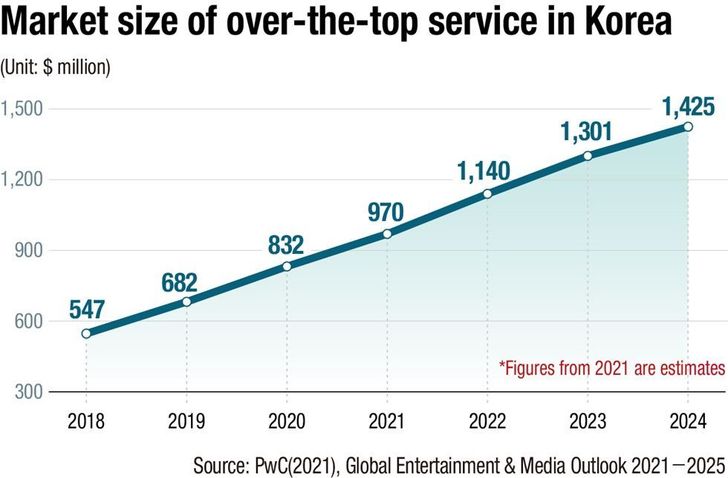
But the global OTT market, which had already been growing before the pandemic, has seen a further boost following the global health crisis, rising in size from $46.3 billion in 2019 to $58.4 billion in 2020. It increased an additional 22.8 percent in 2021 to $79 billion.
In Korea alone, the market grew from $682 million in 2019 to $832 million in 2020.
“Because of social distancing, many people stopped going out to places like movie theaters. So OTT, which allows people to enjoy video content regardless of social distancing, has become a general, common way of media consumption,” Jung Duk-hyun, a media critic, told The Korea Times.
Do Joon-ho, a media communication professor at Sookmyung Women's University, noted that the pandemic has opened up the platform to older consumers, who used to be unfamiliar with the streaming services.
“During COVID, middle-aged people and the older generation also got a chance to grow accustomed to OTT services, which shifted their consumption from IPTV or cable VOD services to streaming,” he said. “For movies, cinema used to be the main source of consumption before COVID, but as the pandemic made it hard for people to go to the theaters, films made their releases on OTT platforms, changing the way people consume movies.”
The music industry also sought an alternative way to deal with travel and gathering restrictions, reinventing contactless live performances and interaction between artists and their fans around the world.
In April 2020, K-pop powerhouse SM Entertainment debuted an online platform, Beyond LIVE, calling it “the first paid online streaming concert service in the world.” The service utilizes the latest technologies to bring real-time performances to viewers as well as enable artists and fans to interact online.
In December 2020, the state-run Korea Creative Content Agency launched KOCCA Music Studio which specializes in online immersive performances through cutting-edge technologies such as XR, augmented reality, and metaverse.
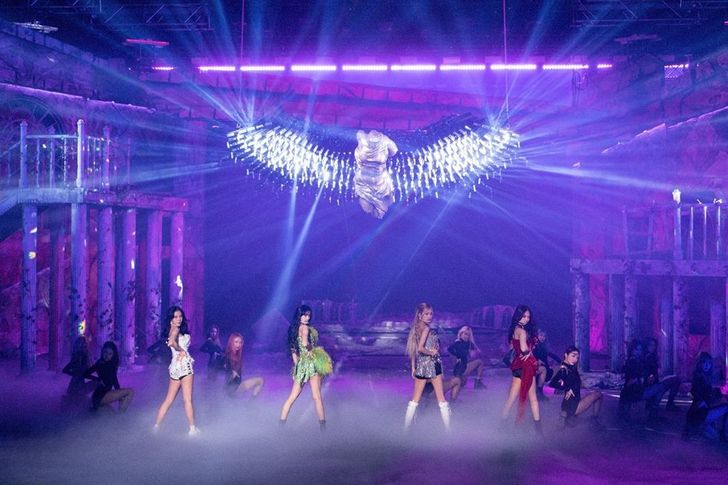
K-pop girl group BLACKPINK performs during its first online concert, "THE SHOW," Jan. 31, 2021. Courtesy of YG Entertainment
K-pop juggernauts like BTS and BLAKCPINK held online concerts and fan events, virtually interacting with global fans via video chat.
Lee Gyu-tag, a cultural studies professor at George Mason University Korea, explained that such online events have become the new norm in Korea's music industry.
“In the past, concerts were something that we should physically go to a venue to enjoy, or otherwise people could watch them later through DVD or blue ray. But nowadays, fans expect concerts to be provided in live feeds online. Of course, it is a different kind of experience, but many have realized the upsides and advantages of enjoying concerts online,” the professor said.
“So for artists who hold concerts frequently, arranging both online and offline concerts together has become a new standard. For example, if it's a three-day concert, they would do both streaming and in-person performances one day and hold only in-person performances for the remaining two days, without being bound by time and space.”
Will COVID-era changes endure?
However, as the pandemic has subsided and people are returning to their normal lives amid eased coronavirus-induced restrictions, the media industry has also been trying to get back on track to pre-COVID times. K-pop artists have increased their activities on the global scene, film distributors have started releasing long-delayed movies, and production studios have resumed overseas filming projects.
Experts have different opinions on which changes will remain and which will return to the pre-COVID times.
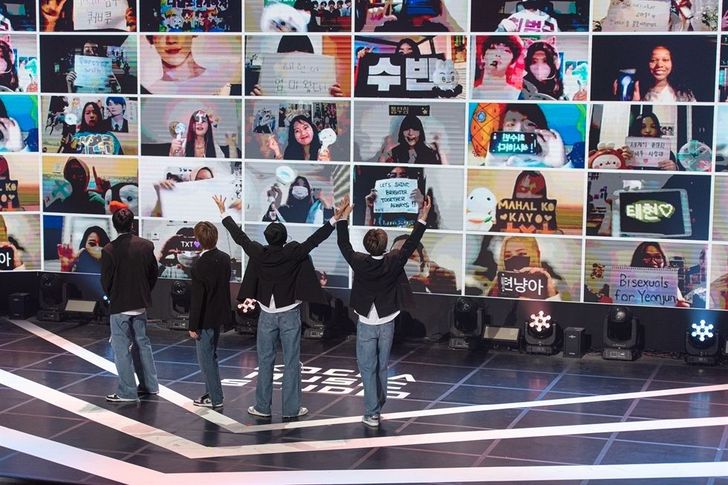
K-pop group TXT holds a concert, “ON THE K : LIVE STAGE,” at the Korea Creative Content Agency's (KOCCA) Music Studio, which specializes in online immersive performances, in this Feb. 19 photo. Courtesy of KOCCA
Although he is optimistic about streaming becoming a common way to enjoy performances, Lee at George Mason University Korea doubted that the immersive and online interaction utilizing metaverse-related technology will fulfill the needs of audiences.
“New technologies for immersive content like metaverse used to be somewhat required as COVID prevented in-person performances. So there were several attempts with the technology. And fans at first took interest but were not really in favor. There were a lot of fans who said those features distract them from enjoying the concert,” he said. “Now that offline concerts are possible, the fans feel seeing their favorite artists interacting with other fans through video chat is a waste of their experience, as they can go to the concert to see the artists' performance.”
He added that the key to adopting new technology in the new trend of K-pop content consumption will be about how well it can capture the artists' performances.
“New, cutting-edge technology is what fans want now. They want to have the same experience of watching the performances on-site, at home through a monitor or a TV,” he said. “So it's not about fancy technologies, but about how realistic the performances are as if they are actually sitting at the concert venue.”
OTT services that enjoyed a boom during the pandemic faced a decline in their user numbers earlier this year when social distancing and travel restrictions were eased.
According to the big data platform, Mobile Index, the overall number of mobile users of the top seven services here ― Wavve, Tving, Seezn, Coupang Play, Disney+, Netflix, and Watcha ― totaled 26.86 million in April, down by about 3.4 million compared to January.

A scene from Netflix's hit series "Squid Game" / Courtesy of Netflix
Jung, the media critic, said OTT services will still account for a huge part of people's media consumption.
“Since we've already experienced subscription-based content consumption through OTT, we know how much content we can enjoy for a certain amount of money every month. So unless there's a film that is made only for movie theaters, we don't need to go there to enjoy media content,” he said.
However, he added that the heated streaming market filled with competitive players will require the companies to take a different approach.
“In the earlier phase, OTT services seemed to have a monopoly over what content to produce and invest in, which might give excessive power to the platforms,” he said. “But now, there are a lot of streaming services in the market. And among those, some will survive and some won't … the key to this competitive market will be content; how they can acquire their original content has become the top priority.”
Do at Sookmyung Women's University noted that the separation between series and movies will become vague. Busan International Film Festival, the biggest film festival in Korea, invited series to its event this year, holding premieres and talk events.
“OTT services have caused series and movies to evolve to become interconnected. It has become harder to separate the two,” he said.