K-beauty: What does it cost to be beautiful?

Plastic surgery clinic signs are listed on a building in Gangnam, southern Seoul, in this April photo. Korea Times file
Some believe K-beauty pushes unrealistic beauty standards
By Dami Kim
DALLAS ― “Her skin is so pale. She seemed so white and pure,” a male contestant on “Single's Inferno,” the hit dating show of 2021, said when he described his first impression of a female contestant. Other male contestants praised the same female contestant and stated she is their type as they “like people who have light skin.”
In 2021, along with “Squid Game,” this hit dating show attracted global attention to South Korea, but it also sheds light on the country's obsession with unrealistic beauty standards.
Hana Kim is a Korean American who thinks the beauty standards in Korea are outrageous and toxic for women of all ages. As young as she can remember, her family suggested plastic surgery as it would make her look “much prettier in Korea.” Her mother even offered her plastic surgery as a graduation gift when she graduated college.
“My mom is definitely the 'almond mom' that's trending on social media these days. She's so obsessed with her weight and mine. I had to work so hard on my self-esteem from the years and years of hearing I'd be prettier if I did this or if I lost some weight,” Kim said.
Kim and her friends even think the country has the highest standards of beauty in all of the world.
Jessica Harris grew up never thinking about plastic surgery as an option for herself. However, living in Korea changed her mind. “Everyone is always talking about botox, nose jobs or the best skincare procedure to get done,” she explains. “It's hard to not think about those things when that's all your friends talk about.”
Harris began to think it would not be a bad idea to upgrade her looks based on Korean standards.
“I went on a blind date with a guy and after our date, he told my friend that I would look better if I lost some weight and got a nose job,” Harris said as she laughed, still in disbelief that someone would say that about another individual. Yet this comment is what ultimately led her to pull the trigger on a 500 million won rhinoplasty at a famous plastic surgery clinic in Gangnam southern Seoul where a large number of beauty clinics can be found.
Harris has no regrets. In fact, she says it was one of the best decisions of her life. “I do have so much more confidence. People keep telling me I have a much softer and feminine look now.” While she has declared no more major surgeries from now on, she does frequent dermatology clinics to get skin care procedures like glutathione injections (also known as “baekokjusa”) to whiten and brighten her skin.
When Harris was asked whether she felt Korean beauty standards are unrealistic, she simply said Hollywood is not any more realistic. “Hollywood also has seriously unrealistic beauty standards. I mean look at Kendall Jenner and Bella Hadid. So many girls want to look like them. I think beauty standards are just unrealistic in general. Everyone photoshops and uses filters these days. I see so many before and after plastic surgery photos of Hollywood celebrities, but everyone makes it seem like Korea is the only one getting procedures done,” she explained.
Harris is correct that Korea is not the only country setting unrealistic beauty standards. According to a report by Dove, appearance hate and discrimination caused by toxic beauty standards is a public health crisis in the U.S.
gettyimagesbank
In this day and age, beauty standards are set by what is shown mostly on social media platforms like TikTok and Instagram. Huffington Post conducted a study on people aged 18 to 34 in which half the participants stated their social media feeds made them feel “ugly or unattractive.”
Supermodels like Hadid are usually the figures that set the standard. Tiny waists, big thigh gaps, big lips and a flat stomach are must-haves to be deemed beautiful in the U.S. With the average U.S. woman wearing a size 16 (typically translated to an XL), these standards truly are not very realistic at all.
While scholars don't have an explanation as to why beauty standards exist, one thing is for sure: Pursuing unrealistic beauty standards can be detrimental to an individual's health.
In late 2021, the Wall Street Journal published the Facebook Files and it uncovered the fact that the company had conducted their own research and discovered that Instagram is a major culprit in making body image issues worse for one in three teenage girls. Instagram has a heavy positivity bias, and users will usually present the most idealized image of themselves. This leads to an unhealthy comparison of an idealized image to an individual's body in reality.
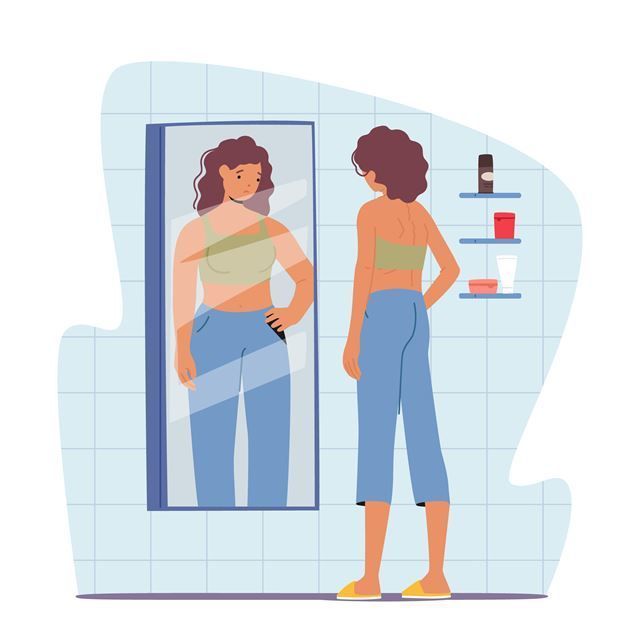
Such comparisons could leave a negative body image in one's head. Research has proven that higher body dissatisfaction puts individuals at risk of unhealthy eating behaviors and drastically brings down their quality of life.
Annabelle Lee was born in 2000, which means she is Gen Z. Growing up as a Korean American, she has been exposed to both American and Korean beauty standards.
When asked which she felt was more unrealistic, she explained, “They're both quite unrealistic in their own ways. In Korea, I think beauty standards are heavily based on weight. There's even an ideal weight and height of 45 kg and 165 cm in Korea, which is very unrealistic for most women even in Korea. In America, weight isn't what's important. It's more focused on certain features ― big and thick lips, an ass that looks amazing in leggings,” she said.
“However, I think Korea's beauty standards have more of a negative effect on me than American beauty standards. When I visit Korea to see family, the first thing they comment on is my weight. It's always along the lines of 'you're so skinny, you look great or you gained so much weight, your cheeks are chubby' and I think about those comments a lot when I look at myself in the mirror,” Lee explained.
She continued, “In America, people usually comment on physical appearance when someone looks better than before, but these days I feel like we've cut back on that too. But you would never hear someone commenting on someone's weight gain in front of their face.”
Lee admitted she struggles with her body image as well. After a trip to Korea last summer, she became somewhat obsessed with her weight. She sought out a therapist that diagnosed her with body dysmorphia.
“I wasn't surprised by the diagnosis. I thought I had it to a certain degree,” Lee stated as she drank her green juice and explained she was currently on a juice detox.
“I think I've gotten a lot better. I'm learning to be more accepting of who I am, but I'm still on social media and when I see a photo of Jennie from BLACKPINK or Wonyoung from IVE, I can't help but compare myself to their perfect pictures,” Lee said.
In America, the #BodyPositivity movement has started to have a positive impact and people are learning to embrace their own beauty with the help of many #BodyPositivity influencers. On the other hand, Korea's beauty standards continue to veer toward a very specific idealized image ― pale, small v-shaped face, pointed nose, plump lips and a very slim body. It is obvious that Korea has some very unattainable and problematic beauty ideals, but perhaps the #BodyPositivity movement can change that for the country just as it is doing for America.
Dami Kim (dami.kim91@gmail.com) is a freelance journalist based in Dallas.