Is K-pop merchandise too expensive?

Pajamas designed by BTS member Jin are being sold for 119,000 won ($99.6) per pair. Capture from Weverse Shop
By Dong Sun-hwa
Last week, numerous fans of K-pop behemoth BTS took to Twitter and other social media platforms to vent their discontent over the high price of cotton pajamas designed by band member Jin, which were being sold for 119,000 won ($99.6) per pair on Weverse Shop ― a commerce platform established by BTS's management company HYBE.
Given that they were more expensive than cashmere sleepwear ― which is usually priced at around 60,000 won to 80,000 won ― their grievances were understandable. Even Jin said he was surprised by the price-tag. Nevertheless, the pajamas still sold out within a few minutes.

BTS member Jin / Courtesy of A Story, Most Contents
The sleepwear is not the only K-pop merchandise that seems overpriced. A plastic water bottle with the name of a K-pop group and its new album is sold for 38,000 won ($32) online, while a simple name tag is priced at 26,000 won ($22).
“K-pop merchandise is so incredibly expensive,” a fan wrote on an online community. “I wanted to buy a key chain featuring a light stick of my favorite group, but it cost almost $35. Companies seriously need to know that some of us are jobless college students trying to get by.”
Another commented, “I feel like we are being treated like pushovers just because we love our stars... I hope the K-pop labels offer us more reasonable prices.”
According to music critic Jung Min-jae, K-pop stars' strong brand power often adds value to such products and raises the price.
“Even if K-pop goods look no different from other products in terms of quality, they are sold at higher prices because they involve K-pop artists,” he said. “They are mainly produced for K-pop lovers, who tend to open their wallets regardless of high prices as a means to support their favorite singers. Most of them already know that a reasonable amount of the profits made from the goods ― especially those with the stars' portraits ― will go to their singers.”
High prices, however, are not deterring the growth of the K-pop merchandise market, with its size reaching 1 trillion won ($841 million) in 2020, according to data released by the Korea Foundation for International Culture Exchange (KOFICE).
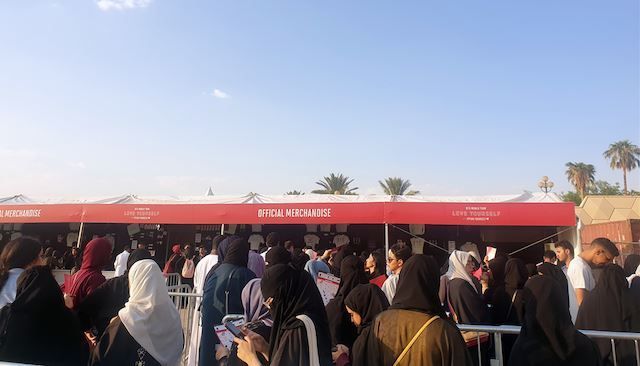
Fans in Saudi Arabia line up to buy BTS-related goods. Yonhap
But why do so many fans loosen their purse strings for expensive items? A former BTS fan in her 20s, who used to buy a bunch of BTS-related goods ranging from photo cards to light sticks, told The Korea Times that she did it out of “love and devotion.”
“I was a teenager when I was a BTS fan a few years ago, and I knew that the prices of most items were too expensive for me to afford,” she said on condition of anonymity. “But I still purchased them because I was so into the group… I felt like I was filling up my treasure chest with these goods. In the case of my friends, some of them even skipped meals and used their pocket money to get the items they want, believing it was a way to support their stars. But they all resold these goods after losing faith in their singers.”
Lee Eun-hee, a professor of consumer science at Inha University, added that popularity of K-pop merchandise largely stems from its “narratives.”
“K-pop merchandise often flies off the shelves, as it has a story on top of function and design,” she explained. “It evokes special feelings for the fans, who relate themselves to their stars by consuming these goods. In the case of Jin's pajamas, those who wear the clothes ― which Jin previously put on to promote his designs ― are likely feeling closer to the singer and keep recalling how he looked when he donned that sleepwear.”
The professor, however, pointed out that the excessive exploitation of K-pop fans' love could deal a blow to the image of K-pop labels and their singers.
“If a lot of fans raise an issue with the prices, K-pop management companies should listen to their voices and make some adjustments,” she said. “Considering that fans are their main consumers, the labels should avoid hurting their feelings. Exorbitant prices can lead many to believe that the companies are only driven by profits, and this could even tarnish the reputation of the singers promoting the merchandise.”
But Jung added that it was still unlikely for K-pop followers to turn their backs on the singers due to expensive goods.
“These fans are less likely to lose their faith just because of the price of the merchandise,” he said. “Unless prices are completely absurd, most fans will continue to spend their money on the goods.”