INTERVIEW Musical 'Aida' prepares for last journey in Korea

Associate director Keith Batten, right, and associate choreographer Tracey Langran Corea of musical “Aida” pose for a photo at Blue Square in Seoul on Nov. 6. Korea Times photo by Shim Hyun-chul
By Kwon Mee-yoo
Disney's musical “Aida” has seen particular popularity in Korea, where it has been running for the past 14 years. Best known for its beautiful music by Elton John and lyrics by Tim Rice, the musical has lived a long life in Korea, over three times longer than its Broadway run.
Associate director Keith Batten and associate choreographer Tracey Langran Corea, sent straight from Disney Theatrical Productions, are busy adding final touches to the fifth and last production of "Aida" in Korea, which opens on Nov. 13.
The musical premiered in Korea in 2005 and has been successful throughout its four previous productions, attracting over 730,000 audience members over its 732 performances.
Seensee Company, which is in charge of the musical's production, said this is going to be the final staging of the current version of Aida, as the Disney theatrical headquarters is in talks of developing a new version of the show.
"A lot of these big musicals are being reinvented after 20-25 years as technologies have changed," Batten said during an interview with The Korea Times on Nov. 6 at Blue Square, where Aida will be staged.
While most of other Disney's stage hits are based on popular animated films such as “The Lion King,” “Beauty and the Beast” and “Frozen,” Aida took a different path. The musical is not based on an animated film, which opened up more possibilities for Aida.
"The original idea was that they were going to do an animated film, but then when Elton John got involved in it, they decided to try doing it as a stage production. It became a more mature musical, giving them an opportunity to do something for more mature audiences rather than children," Batten explained.
The show has a challenge of not having a huge audience worldwide that is already familiar with the material, but Aida gained popularity by word-of-mouth and ran for over four years on Broadway.

trend) musical aida/2019-11-10(코리아타임스)
The musical revolves around Nubian princess Aida, who is captured by long-time enemy Egypt; Egyptian captain Radames, who falls in love with Aida; and his fiancee, princess of Egypt Amneris.
Batten recalled the show's first preview in Korea back in 2005.
"Right from the very first preview, I could feel that the audience was connecting with this musical in a different way than other countries. There was a deeper, spiritual connection and more of a historical attachment, which a Korean would understand," Batten said. "In the U.S., the idea of slavery was more racial, but here in Korea it is more of a national sentiment I think."
Corea added that Aida in Korea is focused more on a spiritual side.
"It has been very fascinating to do it here. Because we don't have visual color difference (among the cast), it takes us more into a story about love, honor and duty versus passion. I think anyone form anywhere in the world can relate to these themes. However, the focus is slightly different here. Slavery or oppression is something that every country can relate to, but it's different depending on what culture you are in," she said.
Batten and Corea have witnessed the changes in the Korean musical theater industry in the past 15 years as they handpicked lead and supporting roles and ensembles of Aida.
Batten said the caliber of the talent has changed. "When we came here for the first time, it was difficult to find dancers who could dance the choreography or singers who could perform it. It was a long audition process before we found a great company, but now 15 years later, there are way more talented people," Batten said. "The talent pool here has really evolved. It allowed us to be more selective."
Corea, who teaches Wayne Cilento's stylish choreography to Korean actors, also said the performers in Korea have grown so much as they have done so many shows.
"For the ensemble, the show is very fulfilling because they have to act and be passionate. I think in the first time, it was hard for the actors to reach the depth of the Nubian struggle and dance with raw emotions in 2005. Now, it is amazing to see how well-rounded everybody is," Corea said.
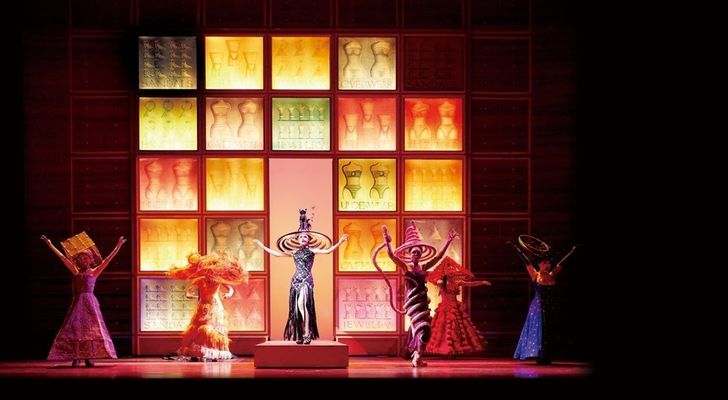
A scene from the Disney musical “Aida” / Courtesy of Seensee Company
The show itself is now nearly two decades old, but the show hasn't become outdated.
"In all elements, Aida is created in a way that is uniquely timeless. So you never feel like it needs to be updated," Corea said.
While Corea polishes up the passion and raw emotion from the show's choreography, Batten balances the show with intimate and dramatic moments of acting, backed by John's music ― who Batten describes as a master of creating emotional connections.
"We are a good partnership. We have to blend elements together. So we always talk about how songs come out of the action. They don't just burst into a song, but step up into a song for a reason," Batten said.
The Korean production uses the set from the original Broadway production, which ran from March 2000 to September 2004. When the Seensee Company bought the license for the show's Korean production, they also purchased the original set and Korean actors sing and dance on the exact same set where Heather Headley, Deborah Cox and Toni Braxton stood on.
Batten appreciated the extraordinary experience of inheriting from the original production, seeing how the work has passed on.
"It has an energy to it. It is like buying an antique at the store versus something your grandmother gave you. It's just special to us," Corea said.
In the new production, a mix of new and returning actors have joined. For Aida, Yoon Gong-ju returns, while Korean-Dutch actress Jeon Na-young steps into the Nubian princess role for the first time.
Batten and Corea said they like Korea's unique "double cast" system in which more than two actors alternate major roles. Batten said the system keeps the show alive as there are numerous combinations of performers, rather than the same cast doing the show same eight times a week.
"It's a unique system for us, but I grew fond of it. They genuinely get support from one another and there is a vibrancy and constant newness as a new person brings new energy," Corea said.
Batten was confident that Korean audiences will once again come to see Aida's final production here.
"Audiences here love the show because it's an emotional journey. Aida has some deep elements of drama and music that heightens emotions. The real, not superficial, depth is what Korean audiences connect to in Aida," the director said.