Samsung ready for PyeongChang Games

Brazilian national water polo players hold the Samsung Electronics Galaxy S7 Edge Olympic Edition at the electronics maker’s Galaxy Studio inside the Olympic athletes’ village in Rio de Janeiro on Aug. 3, 2016. The company offered 12,500 special edition smartphones for all the athletes who participated in the international sporting event. Samsung is expected to offer smartphones to athletes next February again. / Courtesy of Samsung Electronics
By Kang Seung-woo
Samsung Electronics is set to go all-out to help the nation’s first Winter Olympic Games be a success.
The global tech giant has committed to the Summer and Winter Olympic Games as an official sponsor since the 1998 Nagano Winter Games. In 1988, Samsung was a local sponsor for the Seoul Olympics.
With 100 days to go to the opening ceremony of the PyeongChang Games, Samsung has rolled up its sleeves for the nation’s first Winter Olympics, living up to its status as a worldwide Olympic partner.
Samsung is sponsoring the torch relay for the PyeongChang Olympics under the theme “Celebrate the Light.”
The flame that will burn during the Games was lit in Olympia, Greece, Oct. 24, and will arrive in Korea to mark 100 days before the Olympic Games opening ceremony.
A total of 7,500 runners will participate in the relay that covers 2,018 kilometers. The flame will travel to nine provinces and eight major cities in Korea before it arrives at the PyeongChang Olympic Stadium for the opening ceremony, Feb. 9, 2018.
As part of efforts to promote the campaign, Samsung opened a zone in its exhibition hall called “Samsung d’light” from April 18 to May 31 for visitors to experience the torch relay.
Samsung selected 1,500 runners from all walks of life and they included Lee Sang-hwa, a two-time Olympic gold medalist in the women’s 500-meter speed skating, baseball player Lee Seung-yuop, robotics engineer Dennis Hong and its Club des Chefs -- Lim Ki-hak, Lee Chung-hoo, Kang Min-goo and Yim Jung-sik. The group of chefs was launched in 2013 to contribute their unique insight and fresh ideas for creating next-generation kitchen products.
“I am proud of being in the relay for the Olympic torch,” Lee Sang-hwa said.
“The Games will take place in Korea for the first time and I will also seek a three-peat at the Olympics, so it will carry significance.”
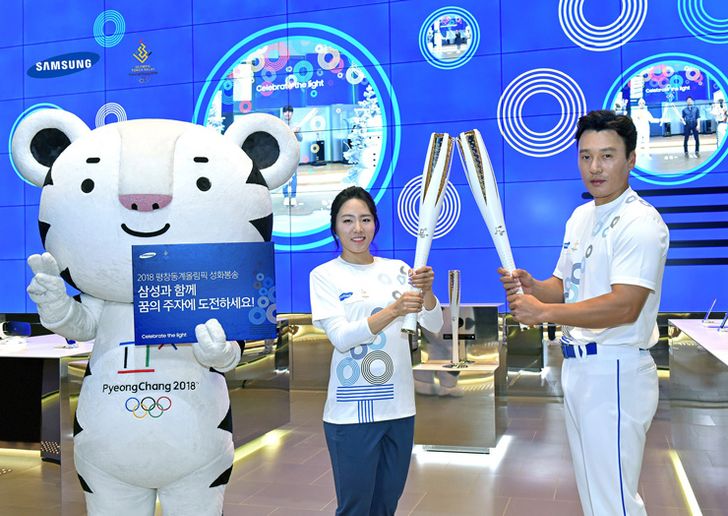
Korean baseball legend Lee Seung-yuop, right, and national speed skater Lee Sang-hwa hold Olympic torches to promote recruitment of additional torchbearers at Samsung Electronics office in Seocho, Seoul, on April 17. The two athletes have been named by the electronics company, which is one of the main sponsors of the 2018 PyeongChang Olympic Games, to carry the sacred fire. / Courtesy of Samsung Electronics
30-year legacy with Olympics Games
After becoming a local sponsor for Korea’s first Summer Games in 1988, Samsung extended its commitment as the worldwide Olympic partner in the wireless communications equipment category. As of the PyeongChang Games, Samsung expanded its partnership, widening the product category to smartphones, tablets, laptops, personal computers, other computing equipment and desktop printers.
In 2014, Samsung agreed with the International Olympic Committee (IOC) to expand its partnership through to the 2020 Tokyo Games in Japan.
“We are delighted to be able to continue our partnership with Samsung. The funding generated by the Olympic partner program directly supports the staging of every Olympic Games, as well as every one of the National Olympic Committees, enabling athletes from all over the world to prepare for and compete at each Games,” IOC President Thomas Bach said.
In 2014, Samsung launched its Sochi Olympic Winter Games mobile app, Wireless Olympic Works (WOW), allowing sports fans to have real-time access to event schedules, latest reports on results, medal standings and Olympic records, reliably and fast.
In addition, the world’s largest smartphone maker gave its Galaxy Note 3 flagship smartphone to all athletes participating in the Games.
The free offer continued in the 2016 Summer Olympics in Rio, Brazil as the Korean firm provided 12,500 Galaxy S7 Edge Olympics special edition smartphones for all the athletes who participated in the event.
Also, it also opened the Galaxy studio in the Olympic Park during the Games, where consumers were able to tryout Samsung’s latest wireless communications products and immersive technologies.
As it did in 2014, Samsung and the IOC launched the official Olympics app, Rio 2016, hitting more than 6 million downloads. The app provided information such as schedules and results of each competition.
Samsung paying attention to Paralympics
Since 2006, Samsung has played a key role in supporting the Paralympics and its efforts will continue in PyeongChang and in Tokyo.
In 2012, Samsung launched a Paralympic commercial titled “Sport doesn’t care who you are,” designed to prompt viewers to rethink their attitudes towards Paralympic athletes.
The film is part of a pioneering initiative led by Samsung to focus people on ability, not disability, and to get them behind the London Paralympics, which drew rave reviews from around the world.
In 2016, Samsung invited children from Brazil’s Disabled Children Assistance Association to offer them a unique experience: live and feel the Paralympic spirit at the Olympic Park.
As part of the company’s efforts to help make the digital world more accessible for those with disabilities, Samsung hosted the children at the Samsung Galaxy Studio in Olympic Park for a fun and immersive tour and hands-on technology experience, where they learned how Samsung’s accessibility technology features can be used in everyday activities.
“Its years-long Olympic marketing activities have helped Samsung establish itself as one of the top global companies,” a company official said.
According to global brand consultancy Interbrand in September, Samsung ranked sixth in its “Best Global Brands 2017” list with $56.2 billion (6.35 trillion won) -- one place up from a year ago. In 2000, Samsung was 43rd at $5.22 billion.