Hollywood, Netflix make inroads into Korean film industry

A scene from Jeong Yoon-cheol’s “Warriors of the Dawn” starring Lee Jung-jae and Yeo Jin-goo. Courtesy of 20th Century Fox Korea
By Jason Bechervaise
This week sees the release of 20th Century Fox Korea’s period epic “Warriors of the Dawn” directed by Jeong Yoon-cheol (“Marathon”). Then on June 29, Bong Joon-ho’s “Okja,” fully funded by the streaming giant Netflix will be released in Korea’s multiplexes as well as online.
The market is changing and it is interesting that Korean directors are deciding to work with Hollywood studios and in Bong Joon-ho’s case, Netflix. No doubt, there are various reasons for this, but creative freedom is evidently one of them.
Last year, it was no coincidence that two of the best films were produced by Hollywood studios. Na Hong-jin’s “The Wailing” and Kim Jee-woon’s “The Age of Shadows” were produced by Fox International Productions (FIP) and Warner Bros. Korea, respectively.
.jpg?w=728)
A scene from Bong Joon-ho’s “Okja” featuring local and international talent: Ahn Seo-hyun, Tilda Swinton, Paul Dano, Jake Gyllenhaal and Byun Hee-bong. Courtesy of Netflix
Although directors like Bong, Kim, Na or Park Chan-wook will generally be given the freedom to do what they wish when it comes to their projects, both “The Wailing” and “The Age of Shadows” were different from other commercial fare. They were more daring both visually and thematically too.
Bong too was guaranteed full creative autonomy on his latest film, though he stated in a recent press conference with the Korean press in Cannes, one of his reasons for choosing Netflix was because of its high budget ($57 million). A locally produced film with this budget would take away funds from other Korean projects meaning fewer films could be made.
Going back, FIP invested in local productions in 2010 with a 20 percent stake in Na’s “The Yellow Sea.” Then in 2013, they fully financed “Running Man” starring Shin Ha-kyun and directed by Jo Dong-ho. It wasn’t a big hit with critics, but it did manage to accumulate a respectable 1.4 million admissions at the box office.
Their next project “Slow Video” (2014) directed by Kim Young-tak featuring Cha Tae-hyun and Nam Sang-mi and, more comedic in nature, pulled in over 1.1 million viewers. Certainly not a spectacular success, but not a disastrous tally either.
However, FIP’s third film, “Intimate Enemies” (2015) was a catastrophic failure. Ironic perhaps, given that it was the first film to be helmed by a director with a strong reputation both locally and overseas, Im Sang-soo.
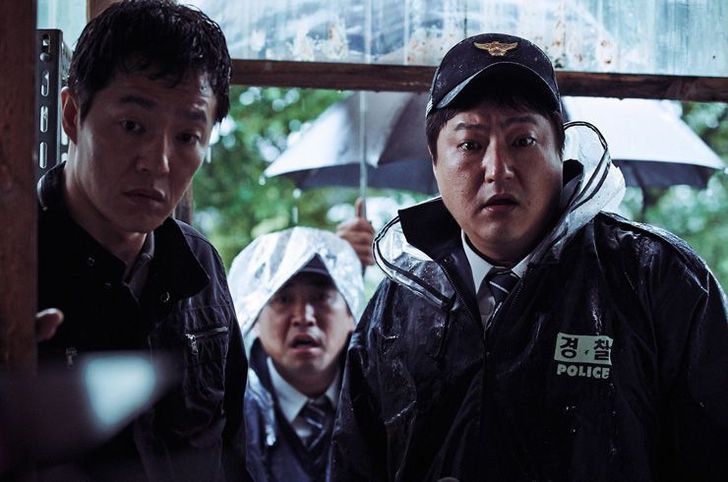
A scene from Na Hong-jin’s “The Wailing” starring Kwak Do-won and Hwang Jung-min. Courtesy of 20th Century Fox Korea
The film bombed at the local box office attracting a measly 133,533 admissions, and it failed to travel on the festival circuit. Critically too, the film was seen as bit of a mess.
But the studio made an emphatic comeback last year with Na’s acclaimed “The Wailing” that was invited to Cannes and was FIP’s biggest locally produced hit yet amassing an impressive 6.8 million admissions fuelled by strong word of mouth.
Also released last year was Warner Bros.’ first Korean-language project “The Age of Shadows” that repeated the success of “The Wailing” locally selling 7.5 million tickets, while on the festival circuit it was invited to a major European film festival, Venice, and then went to Toronto.
Warner Bros. Korea also financed the low budget film “Single Rider” starring Gong Hyo-jin and Lee Byung-hun released earlier this year.
For the Hollywood studios, it makes sense to enter the Korean market. Koreans on average see four films per year; two of which are local films, with total annual theater admissions surpassing 200 million for the past four years. Therefore, it is seen not only as a major market for Hollywood films along with China, Japan and countries in Europe such as the U.K. but also one in which the local industry thrives.

A scene from “The Age of Shadows” starring Song Kang-ho alongside Gong Yoo. Courtesy of Warner Bros. Korea
A further incentive is found when one considers the abundance of talent found in Korea, and not just in terms of directors. Actors, actresses, cinematographers, writers, producers, composers, editors and so on and so forth make an immense contribution to what is seen as Korean cinema. This is why the production values in Korean films are generally very high, and a factor behind the growth of Korean cinema overseas. It thus makes sense to invest in local content.
But what is crucial is that these studios understand the Korean market, which is why FIP Korea is headed by Kim Ho-sung, an established and talented producer (“Masquerade”) and the Warner Bros. Korea chief is Jay Choi (“The Attorney”), a very influential film producer. They then collaborate with local production companies to make Korean-language films.
Netflix has a presence in Korea through its online service, but is also reliant on local partners such as Lewis Pictures which produced “Okja” to make their Korean-language content. Lewis Pictures is collaborating with Kim Jee-woon on his next film, “Jin-Roh,” which is being financed and distributed by Warner Bros. Korea.
What is also striking is the pace of some of these productions. While “The Wailing” was in post-production for over a year, “Jin-Roh” goes into production in July less than a year after “The Age of Shadows” was released.
Looking ahead, Park Hoon-jung’s spy thriller “V.I.P.” _ also a Warner Bros. Korea title _ is expected to be released later this year. The studio is also to produce Lee Jeong-bum’s “Bad Lieutenant.”
Turning to the present, industry observers will see whether FIP can replicate the success of “The Wailing” with their new project “Warriors of the Dawn,” which is the first period film to be financed by a Hollywood studio. Starring Lee Jung-jae, it follows a group of proxy soldiers who try to protect a new crown prince.
But the question many are asking is regarding “Okja.” Will audiences flock to the cinema when the film is also available online? The implications for the local and global industry of such a release could be far reaching.
Jason Bechervaise is a movie columnist for The Korea Times. He can be reached at jase@koreanfilm.org.uk.