Japan shuts down path to forced labor site
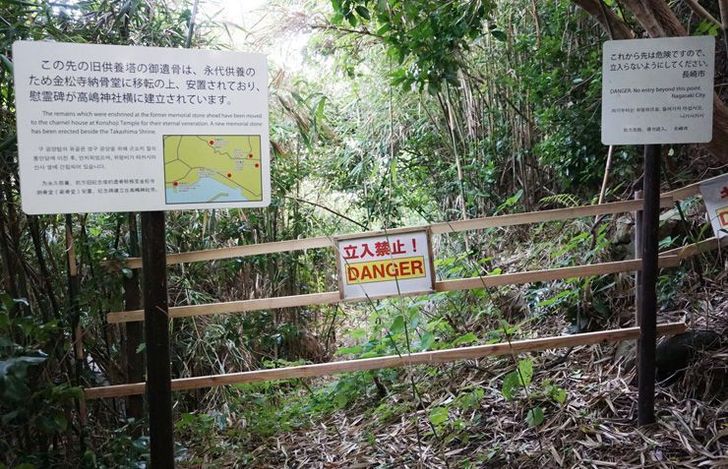
The entrance to a path leading to a site in Nagasaki honoring conscripted Korean workers during the 1910-45 Japanese colonial rule is blocked by wooden planks. Yonhap. / Yonhap
By Yi Whan-woo
The municipal government of Nagasaki in Japan has shut down the only path to a site honoring Koreans who were forcibly taken to work on two islands off the city’s coast during the 1910-45 Japanese occupation of Korea.
Suh Kyung-duk, a Sungshin Women’s University professor who has devoted himself to uncovering Japan’s wartime crimes, said Thursday three large wooden planks were set up at the path’s entrance preventing public access to a memorial stone, which has become a popular attraction for Korean visitors. The remains of unidentified Korean coal miners on the islands of Hashima and Takashima are believed to be buried underneath the memorial stone.
This is a clear violation of Japan’s promise to UNESCO in 2015 to correctly address the issue of forced labor on Hashima.
The site was among the 23 historical settings that won UNESCO world heritage recognition in July 2015 for representing the industrial revolution of Japan as an economic powerhouse during the 1868-1912 Meiji period.
In line with Seoul’s demand, the Japanese delegation acknowledged back then that a large number of Koreans “were brought against their will and forced to work under harsh conditions in the 1940s” at some of the 23 sites. It also promised to set up an information center explaining the circumstances under which Koreans toiled.
An estimated 59,000 were taken to seven of the 23 sites, such as coal mines, shipyards and steelworks to produce fuel and military equipment.
“I visited the site after getting a tip from the online community,” Suh said. “It was impossible to pass through the wooden planks.”
The Nagasaki city government governs the two islands, where Mitsubishi, a Japanese conglomerate, operated coal mines in the past.
Suh said both of them blamed each other over who was responsible for attempting to prevent people from visiting the memorial stone and learning about Japan’s wartime crimes.
“The city officials said they moved the remains to a temple close to the memorial stone, hinting that public access to the stone is no longer necessary,” he said.
“But when I contacted the people at the temple, they said they had no clue as to the whereabouts of the remains. Citing that Mitsubishi installed the memorial stone, they directed us to contact the company, which responded that the Nagasaki city government exclusively deals with related issues.”
A growing number of Koreans have become aware of the memorial stone after Suh appeared on a popular TV reality show and took its crew to the site in September 2015.
“The Nagasaki city government may have closed the path because it was afraid of growing awareness toward Japan’s dark history and found it humiliating,” Suh said.
Despite its UNESCO pledge, Japan only has been highlighting Hashima as evidence of Japan’s rapid industrial development as the first non-Western nation to do so.