Allies united on N. Korea
Park Geun-hye
By Chung Min-uck
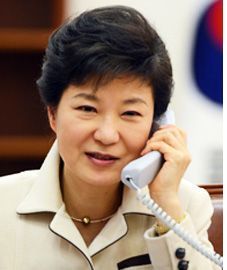
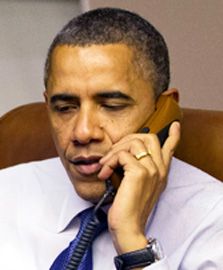
President Park Geun-hye and U.S. President Barack Obama reaffirmed their commitment to joint efforts on the North Korea nuclear standoff in a 20-minute phone talk, Monday, according to Cheong Wa Dae.
The phone conversation came a day after Pyongyang offered to hold high-level talks with Washington.
“Obama briefed Park on the outcome of his summit with Chinese President Xi Jinping and exchanged views on a broad range of issues relating to North Korea,” said presidential spokeswoman Kim Haing in a briefing. “Obama said he had asked for Beijing’s cooperation for North Korea’s denuclearization as its nuclear and missile programs pose a big threat to peace in Northeast Asia.”
According to Kim, Obama also told Park that Xi expressed China’s commitment to a nuclear-free Korean Peninsula and promised not to recognize Pyongyang as a nuclear weapons state.
“Park and Obama agreed to continue to work closely on North Korea and other major issues,” Kim said.
Although Kim declined to comment on whether they discussed Pyongyang’s dialogue proposal, observers believe the presidents confirmed their stance not to engage in dialogue until the North proves its seriousness about its offer through actual denuclearization steps.
A Cheong Wa Dae official later said during the conversation Park opined that holding “talks for talks” with North Korea would only give it time to “raise its nuclear ability.”
The North called for high-level talks with the United States, Sunday. The communist country said the agenda for the talks would include easing of military tensions on the peninsula, replacing the armistice that halted the Korean War (1950-53) with a permanent peace treaty and discussions on U.S. goals for a nuclear-free world.
Washington, however, effectively turned down the proposal asking Pyongyang to take concrete actions on its denuclearization first.
In the meantime, Chinese vice foreign minister Zhang Yesui will meet North Korean first vice foreign minister Kim Gye-kwan in Beijing, Wednesday, Foreign Ministry spokeswoman Hua Chunying said at a regular briefing.
"The two sides will exchange views on bilateral relations, the situation on the Korean peninsula and international issues of common interest", she said, adding that the talks were part of a "strategic dialogue" between the two countries’ foreign ministries.
Experts say South Korea and the U.S. are successfully maintaining a united front against North Korea’s tactical move to remove itself from the present impasse by separately calling for bilateral talks.
“North Korea is experiencing international isolation faced with a coordinated approach between South Korea and the U.S., and China’s firm determination for its denuclearization,” said Hong Kwan-hee, a North Korean studies professor at Korea University.
“It’s essential for the two allies to maintain close cooperation as North Korea seeks to cause a rift by approaching each country separately.”
The proposal came less than a week after inter-Korean governmental talks were canceled over disagreements on the rank of officials appointed to represent the two sides at the meeting.
In both of the proposals, North Korea failed to mention scrapping of its nuclear programs which has long been a pre-condition for Seoul and Washington to engage in dialogue with the bellicose Kim Jong-un regime.
Recently, international pressure has been mounting on Pyongyang as Beijing, its only remaining ally, on numerous occasions, urged for its denuclearization as well.
In the landmark summit between Washington and Beijing earlier this month, Obama and Xi officially concurred that the North should give up its nuclear programs for peace on the Korean Peninsula.
China has expressed frustration against its ally North Korea, particularly after the North’s third nuclear test in February.
President Park is also bracing to meeting her Chinese counterpart at the end of this month.
Meanwhile, sources say there is the possibility of holding trilateral talks with foreign ministers from South Korea, the U.S. and China on the sidelines of a regional security conference in Brunei later this month.