Park, Abe to counter N.Korea
By Kim Tae-gyu, Kang Seung-woo
.jpg)
Park Geun-hye
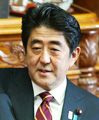
President Park Geun-hye and Japanese Prime Minister Shinzo Abe agreed Wednesday to jointly counter North Korea’s increasing provocations.
Cheong Wa Dae said Abe made the offer in a phone call to Park to congratulate her on being inaugurated as President.
“Abe asked Park to visit Japan so that the two states can set up a future-oriented relationship,” Park’s spokeswoman Kim Haing said. “The two leaders also agreed to cooperate in dealing with North Korea.”
The agreement came as China is backing new U.N. sanctions against the North, which are dubbed as “some of the toughest” in the organization’s history. A vote for adoption is expected today.
At the same time, Seoul has not let up its preparedness with the Ministry of National Defense stating it will not tolerate any military action, and will strongly punish Pyongyang and its leadership.
"The North has already received notice that South Korea-U.S. drills are defensive in nature," said Army. Maj. Gen. Kim Yong-hyun, a senior official at the Joint Chiefs of Staff, at a press conference.
"If North Korea goes ahead with provocations, and threatens the lives and safety of South Koreans, our military will strongly and sternly retaliate against its command and support forces. We want to make it clear that (our military) has made all preparations to do that."
What will North Korea do next, if international sanctions hit it? According to experts, it has a limited list of options that will raise tension on the Korean Peninsula. It already used one Tuesday, threatening to nullify the 1953 armistice that ended the Korean War.
The sanctions will add further pressure on the North, but the reclusive state is running out of options.
“Rather than a fourth nuclear test, they will stick to a Northern Limit Line (NLL) incursion or a potential submarine provocation that we cannot respond to right away,” said Shin In-kyun, president of the Korea Defense Network.
However, he said there is little chance that the two countries will fire upon each other, let alone engage in full-scale war.
“The North wants to avoid engaging in a full-scale war even more than the South because the combined forces here with those from the United States are far stronger than the North,” he said. “Although the South’s military will formulate strong actions, they will not expand these to a full-scale war.”
Kim Seok-hyang, a professor at Ewha Womans University’s Graduate School of North Korean studies, said the North’s recent rhetoric reflects the fear they are feeling.
“The North, especially the high-ranking military officials there, knows that they would be devastated if the U.S. and South Korea actually conducted a military attack on them. They are running out of options following their third nuclear test and their recent words prove that,” Kim said.
Also among the North’s cards is a fourth nuclear test. There are reports that the North has prepared for another test after its latest one on Feb. 12.
It can also test-fire a new rocket, although this would take some time.
In both cases, pressure from the international community will likely be raised, and its isolation will become deeper.
Analysts did not rule out the possibility of the North relying on another nuclear gamble as the last option.
“From the viewpoint of North Korean leaders, nuclear weapons and long-range missiles are the surest way to beef up their control,” said Chang Yong-seok, a researcher at Seoul National University’s Institute for Peace and Unification Studies.
“Pyongyang can immediately attract interest with nuclear arms and missiles. In the short term, they have hardly any incentive to give them up.”
Over the long haul, however, Chang said the North had better abandon its nuclear ambitions and open the country to outside investors so that it can chalk up economic growth.
Since noon Wednesday, the alert level for South Korea’s military has been raised, in order to better monitor any signs of provocation from the North.
On Tuesday, the North said, “We aim to launch surgical strikes at any time and (at) any target without being bounded by the armistice accord.”
Given that Kim Yong-chol, a hard-line North Korean general, issued the menacing statement, the chances are high that the verbal threat could translate into military action. Kim is suspected of involvement in the sinking of the South Korean naval ship Cheonan and the shelling of Yeonpyeong Island, both of which took place in 2010.
A North Korean artillery unit conducted a simulated fire drill targeting Seoul on the inauguration day of President Park Geun-hye on Feb. 25, according to a government official. The North is expected to carry out a large-scale nationwide military drill in early March.