Poet tells people to embrace imperfections
By Choi Yearn-hong
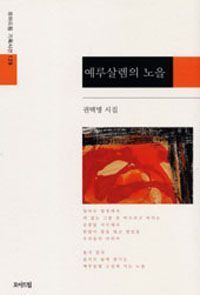
“Evening Glow of Jerusalem” by Kwon Taek-myung
There are many famous and not-so-famous poets in Korea, and I have come to know a few of them, including Kwon Taek-myung, from a distance. I am glad to have read his most recent poetry book, “Evening Glow of Jerusalem.” As a poet, he is also known for translating famous Japanese poems into Korean and for advocating poetry and cultural exchanges between Japan and Korea.
I figured out his Christian belief from the title of the book. He is known as a church elder and became the Korean representative of the Pearl Buck Foundation after his retirement from the Foreign Exchange Bank in Seoul. I paid attention to his poems because he was a protege of the late poet Park Mok-wolI, whom I admired a lot and with whom I became acquainted and communicated with in the 1960s during my days at Yonsei University. A lecturer at my university, Park read and complimented my poems that were published in the Yonsei Annals. Back then, the caring seasoned poet invited me to his house at Wonhyo-ro near the Han River, the last stop of the electric car. I visited him more than a few weekends before I left Korea for the United States to continue my advanced studies. So Kwon and I shared the same poetry mentor, even though Kwon was about a decade younger than I was.
How did I eventually come to know Kwon? Through Facebook. I appreciate Facebook for facilitating human connections in this world. Korea and the United States are only within a short distance of each other in cyberspace. Networking is not always good, but when it is, networking is beneficial to the good people in this world. Poetry is a good reason to network. Kwon sent me his beautiful five-part poetry book about his daily city life, the changing seasons and landscapes, nostalgia for his hometown in Gyeongju and his beloved parents, love songs and his spiritual life. To fellow citizens, his poetry may be a guiding light to the positive aspects of life. His language is humble, so I appreciate reading his poems. He seems to say being Christian means an acceptance of his imperfections, so he seeks God’s guidance to improve. I guess Park, who was also the publisher and editor of the poetry magazine, Simsang, Image, set an example to Kwon, with whom he worked closely as a mentor. To Park, who is an imagist, poetry is an image. Time has brought changes over the decades, but the heart of poetry remains an image. I consider myself an imagist poet as well, and so does Kwon.
In “Mother’s Dream,” one touching poem in this book, Kwon regretted never asking his mother what her dream was when she was young. After she passed away, he realized that he did not ask the simple question, “Mom, what was your dream as a young woman?” He was sure that his mother had her own dream as a young woman before she married her husband and became a mother to her children. I had the same feeling of despair after my mother passed away. I asked myself, “Why didn’t I sing a lullaby to my mother?” She would have appreciated me singing a lullaby to her while she was bedridden and in her old age. I’ve always considered the lullaby as a mother’s song for her children. Korean mothers sacrifice their lives for their families and children. They save the good food for their children and put their own health and welfare last. However, children often take their mothers’ sacrifices for granted.
What made Korea move forward from a poverty-stricken, war torn country to an advanced nation was a mother’s constant prayer for her children. After a mother passes away, her children realize, albeit too late, that their mother never received anything in return for her sacrifices. The poet Kwon, much later in his life, thought about his own birth in the year 1950, the beginning of the Korean War. His rural house was occupied solely by his old mother, and the empty rooms must have reflected the emptiness of her life in her later years, after her children had grown and left for the city. Kwon’s filial piety is sad but remarkable in his poems; it makes for somewhat tearful but beautiful poems.
Kwon wrote seven poems about the first snow for this poetry book. The first one is short, and I translated it for this article.
'The Road Covered by the First Snow Fall'
At pre-dawn darkness.
Two lines of footprints.
The person must have walked to heaven
All the way by foot.
A beautiful image from the first heavy snow covering the world is presented well in the poem. His Christian spirit appears often in this series of first snow poems. In front of the snow-covered vast land under the bright sun, he felt he lost his ability to see daily human affairs. However, he also declared that even if your sins are scarlet red, the first snow will purify and clean your sins with white. All in all, his poetry praises the blessings from heaven that sustains his life. The last part of the book is all about the religious but poetic pilgrimage to the Holy Place. In the evening glow of Jerusalem over the olive grove, Jesus asked him not to show his tears. Jesus, as he rode on a donkey at the entrance of the city of Jerusalem, already knew the crowds would demand his death at Pilate’s court. So he asked Kwon not to cry when he traveled to Golgotha Hill, or Calvary. His poems on Christmas and The Resurrection are religious but convey their meaningful messages to non-believers as well.
I recommend this poetry book to poetry-loving people inside and outside of Korea.
Dr. Choi is a poet in the Washington D.C. area.