Remnants of war

Foreign tourists experience tension between two Koreas
This is the first of a two-part series on “security tourism,” a growing tourism trend of traveling to destinations near the inter-Korean border — ED.
It was raining heavily in the morning on the way to the demilitarized zone (DMZ), a couple of weeks before the 63rd anniversary of the start of the Korean War on June 25.
Had the government officials of both countries managed to proceed with the inter-Korean meeting, the day of the tour would have marked the first face-to-face contact at a senior level in six years.
But North Korea called off the talks at the last minute after a disagreement over the level of chief delegates attending the meeting.
The relationship between the two has been turbulent since the first North Korean nuclear test seven years ago. The succession of Kim Jong-un in Pyongyang has made things even trickier as the young leader continues to create drama to solidify his presence.
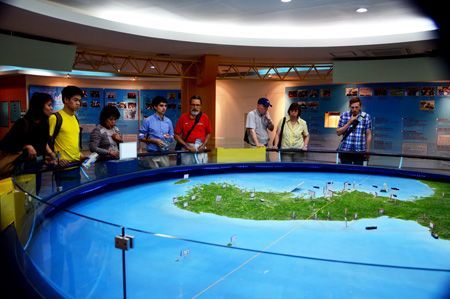
Tourists take a look at the “unification topographical map” on the second floor of the Odusan Unification Observatory in Paju, Gyeonggi Province.
In April this year, North Korea threatened to fire missiles across the Korean Peninsula. Weeks after, the precarious Gaeseong Industrial Complex was shut down entirely.
These are testy times for the two Koreas and officials in Seoul are concerned about the political and economic effect of the heightened uncertainty.
But if there is one area in the country that seems to benefit from the increased tension, it’s “security tourism,” a growing tourism trend driven by the popularity of traveling to destinations near the inter-Korean border.
The trip
The DMZ tour run by the Panmunjom Travel Center (PTC) began in front of Lotte Hotel in central Seoul. At 9:30 a.m., about 20 people hopped on a bus which drove the group for over an hour to the Odusan Unification Observatory, the first destination of the trip.
PTC, out of the numerous travel agencies offering DMZ tours, was the only one that provided a guided tour by a North Korean defector. It was also the only agency that specialized in DMZ tours.
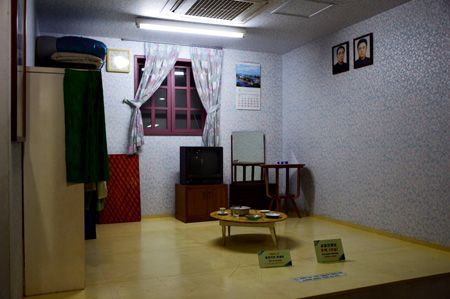
A model room of a North Korean school principal.
At the observatory, the group was led to the second floor of the building where the “unification topographical map” is displayed in the middle of the hall. North Korean cities and several regions carrying historical significance were marked on the map.
The English guide gave a brief explanation about the marked points and then the North Korean guide pointed to the region where she was from and where she escaped to when she was fleeing from her country.
After briefly observing the North Korean side at the outdoor observatory on the third floor, the group went down to a theater to watch a short film about life in North Korea.
On the first floor of the observatory, there was a model of a North Korean elementary school classroom. The group sat on the chairs inside the classroom and asked questions to the North Korea-born guide whose response was translated by the English guide.
.jpg?w=728)
A military policeman stands guard inside the Panmunjeom building in the Joint Security Area.
The questions were predicable: “Do people really starve in North Korea?” “Are people really executed in North Korea?” “Do most North Koreans wish to flee the country?” “How much money do they save up to flee the country?”
The guide answered earnestly, although the answers were short due to limited time.
Before heading to lunch, the tour bus stopped at Imjingak for 15 minutes. Imjingak, a major security tourism destination consisting of a unification park and several monuments, lies seven kilometers south of the military demarcation line.
The un-crossable line
After lunch, the tour to the “real” tension zone began. The group arrived at Camp Bonifas, the United Nations Command military post located 400 meters south of the South Korean boundary of the demilitarized zone. The UN forces are in command of the Joint Security Area (JSA), which includes Panmunjeom, the conference building located within the JSA.
The JSA is an area divided by two lines — one on the North and one on the South Korean side— which divide the two countries. Panmunjeom is located in between the two lines and is 62 kilometers northwest of Seoul and 10 kilometers away from Pyongyang, the North Korean capital.
Panmunjeom was where the armistice agreement calling for the cease-fire of the Korean War was held on July 27, 1953. It is now used as a meeting room between the two Koreas on important occasions.
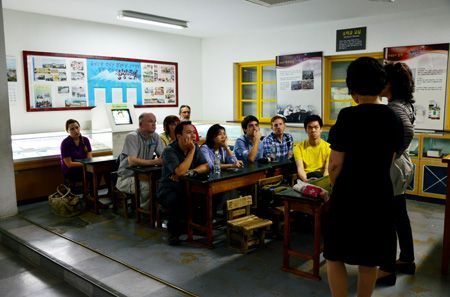
Tourists listen to an explanation from the guides inside a model of a North Korean elementary school classroom at the Odusan Unification Observatory in Paju, Gyeonggi Province. / Korea Times photos by Yun Suh-young
What is interesting inside Panmunjeom is that the division of South and North Koreas within the building is set by the meeting table. The northern half of the table is where North Korea begins and the southern half of the table is South Korean territory.
The exhilarating experience inside the building is that visitors can actually step on North Korean territory, north of the meeting table.
A U.S. soldier who guided the group told an interesting story of how the representatives from the two countries began to take breaks in between meetings. The two sides used to continue the meetings for 11 hours but would not go to the restroom unless the other side stood up first. “Both parties thought it was a sign of weakness,” he said. But that became a problem and the two sides agreed to take mandatory break every two hours since then.
The group wasn’t allowed enough time to stay inside Panmunjeom. The photo time was five minutes and after a total of 15 minutes, visitors were led outside.
On the way back, the bus stopped in front of the “Bridge of No Return” and the “Place of the Yellow Poplar Tree,” but the tourists weren’t allowed to step out. The Bridge of No Return stretches across the military demarcation line and was named so because when prisoners of war crossed the bridge to the northern side, they could not return home.
The place of the poplar tree is a site where a small monument is set up to commemorate the “axe murder incident.” Two U.S. soldiers — Captain Arthur Bonifas and Lieutenant Mark Barrett— were murdered by North Korean soldiers in 1976 while trimming the tree that was blocking the view from the observation post.
The North Korean soldiers had considered the tree cutting act as a military aggression. Since then, the soldiers from each side who used to freely walk around the JSA were ordered to stay within the lines. Camp Bonifas was later named in honor of the late commander.
North Korean guide
While seeing the DMZ in person was eye-opening, the most memorable part of the tour was talking to the North Korean defector guide, who went by the name Kim Ha. Her stories were simply mind-boggling.
“I jumped from a four-story building and landed on the roof of the first floor entrance while I was captive in China. Out of the eight people who attempted escape with me, only I survived. I don’t know what happened to the rest,” she said, looking out the bus window.
“I’m not sure they even tried to escape. I was brave enough to jump because I was trained in the military for over 20 years. I had to jump within one minute to avoid the search light. The others were afraid to jump even if they were male.
“Whenever I lecture at the military bases in South Korea, I tell them to train not just for the country, but more for themselves in order to survive in whatever situation.”
Kim served in the North Korean Navy after graduating from middle school. She was handpicked by authorities for being one of the “best, brightest and good-looking,” which she says were the standards for selecting female military officers.
In order to make money to survive, Kim and a friend smuggled drugs into China but when the friend was caught and executed, Kim knew she had to flee to the South.
She arrived in Yunnan, China, with her fellow escapees but was caught by police and detained for questioning. She jumped off the building the day before questioning.
“I knew I had two choices. Either to jump or be sent back to North Korea. I knew I would die if I was sent back. So I chose to escape. That too came with the risk of death but I thought ‘why not die trying?’”
Her bravery was rewarded. She escaped through a slim sewage channel beneath the fence around the building. She cut her face while trying to squeeze through. Blood smeared all over her face and body but she ended up free on the opposite side.
“I immediately ran to a phone booth where I could call up a broker. I remembered the number of one broker who could help me get out of this country,” she said.
She stayed in China for 16 months. Through Laos, Cambodia and Thailand, she finally arrived in South Korea in 2011. At the beginning, she made a living by washing dishes at restaurants. Now she works as a travel guide at the PTC as a regular employee and lectures at military bases every now and then.
“It’s comforting to know that I get paid regularly every month. I’m glad I can finally stand on my own.”
Mind opening experience
Those who participated on the trip all seemed to have come with intense curiosity about the divided peninsula and to experience the tension that they have only heard about through the news.
“When I encountered the news about Gaeseong Industrial Complex, I wondered ‘Was the situation that serious to the point they would shut it down?’ So I wanted to go and see how the real situation was between the two Koreas. And Panmunjeom was close to the complex,” said Kobayashi, a construction worker from Japan.
“After visiting the DMZ, I felt pity and sorrow for the divided country. I miss peace. The relationship between Asian countries is also deteriorating. I wish we would all help each other out and live peacefully.”
Others wanted to see for their own whether the threatening news was really true.
“When I watch news in my country, I feel that it’s exaggerated. They like to make it more sensational so that more people would read, watch or listen to their media. When I said I was coming to Korea, people would ask me ‘Is it safe?’ And I said, ‘Yeah, my son says so,’” said Mike, a chiropractor from the United States, whose son lives in South Korea.
“When we watch American news, they make it seem like war is going to break out any time. But life is as usual here. I didn’t feel any threat while visiting Korea. But I was curious to see how the DMZ was.”