What's in store for hotel market in 2013 2014
By Soo Jin
In 2011, Korea reported another annual record high of 9.8 million foreign arrivals ― up 11 percent from 8.8 million in 2010. The robust growth in foreign arrivals directly benefitted the Seoul hotel market because up to 80 percent of foreign visitors head to the capital.
The majority of foreign visitors come from the Asia Pacific region, including 34 percent or 3.3 million from Japan, 23 percent or 2.2 million from China and 7 percent, or 700,000, from the United States. The growth is again mainly driven by Chinese visitors, whose number grew by 18 percent.
The outlook for 2012 is also positive as total foreign arrivals in the first half of 2012 increased by 23 percent from the same period in 2011. Supported with an enhanced image as one of Asia’s major shopping destinations, along with the strong interest in Korean pop culture in the region, tourism arrivals are expected to continue to remain strong in the near future.
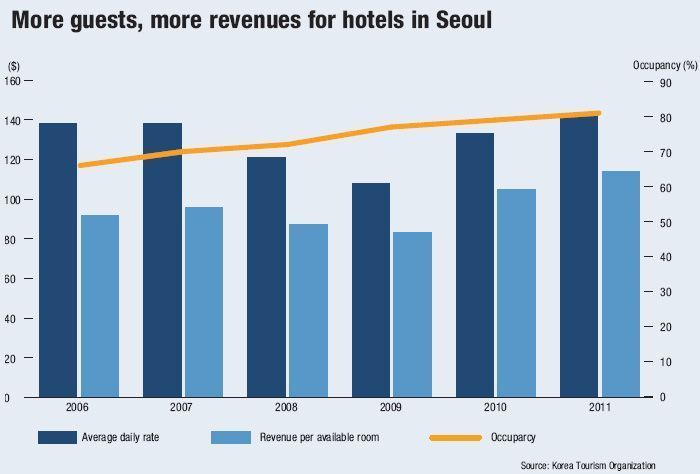
Seoul’s hospitality industry showed strong growth in 2011 with flourishing demands. According to the Korea Tourism Organization (KTO), the 2011 market-wide average occupancy rate was 81 percent, showing a slight increase from 2010. The market-wide average daily rate, the average realized room rental per day, also grew by 2.5 percent in 2011, reaching 157,116 won ($142). It rose at a more moderate pace after a sharp increase of 11.4 percent in 2010 from the previous year. Overall, revenue per available room increased by 4.8 percent.
In 2011, the super deluxe hotel market, which includes upscale and above tiers recorded a 5.6 percent increase in revenue per room as a result of a stable occupancy rate of 79 percent and an increase in the average daily rate at 7.2 percent. If this rate is converted to U.S. dollars using the annual average exchange rate due to the relatively stronger won in 2011, the revenue per room grew by 10.2 percent.
The deluxe market, consisting of upper, midscale and some hotels of lower quality in the upscale tier, also performed strongly with growth in revenue per room at 13.1 percent based on the dollar, mostly due to an increase in the occupancy rate.
Likewise, midscale properties performed strongly with a growth of revenue per room at 15.4 percent, in dollars, while the economy tier showed sluggish growth due to a decline in average daily rate.
The current healthy market performance is expected to continue throughout 2012 and in the near future until room supply grows substantially.
According to official statistics, Seoul had 148 properties with 25,160 rooms as of Dec. 31, 2011. The super deluxe and deluxe markets comprised approximately 64 percent of the total room inventory. Along with the current push by the government to increase room supply and the favorable market conditions, a large number of new hotels are currently in the pipeline.
According to a recent city government report, more than 12,700 rooms are planned to enter the market by 2015, indicating that Seoul’s total room supply will almost double over the next three years. The majority of this new supply is expected to be mid-tier products, although a few projects are expected to accommodate new comers among global luxury brands in core districts within the next three to four years. This will set a new benchmark in terms of rate and product quality for the city of Seoul.
Outlook
Korea’s economic growth is anticipated to be strong over the coming years. All of the big three credit rating agencies, Standard and Poor’s, Fitch and Moody’s, have recently raised the country’s sovereign credit ratings by one notch each to the fourth-highest level, citing its strong fiscal position, economic resilience and reduced external vulnerability of the nation’s banks.
Furthermore, the Korea-U.S. Free Trade Agreement, which became effective in March 2012, should support the nation’s economy to expand by 5.7 percent and create 350,000 jobs within a decade, according to government estimates. Along with three other fast-growing countries, collectively referred to as “MIST” nations (Mexico, Indonesia, South Korea and Turkey), Korea has now emerged as an attractive alternative for investors searching for a propitious investment place after the BRIC countries (Brazil, Russia, India and China).
Demand is expected to grow robustly in the medium term especially due to the healthy Chinese market and a favorable leisure inbound market. Concerns remain over the strengthening Won, which would hinder attracting price-sensitive leisure travelers. Yet, the economic rebound may boost business demand, countering the potential shortfall in leisure demand.

Overall, the KTO estimates that foreign visitor arrivals might grow at an annual growth rate of 7 percent to 8 percent over the next decade, which shows a confident outlook for demand growth. However, due to the expected additions to supply, hotels in the city could suffer some downward pressure, should unexpected fluctuation in demand occur.
Soo Jin is senior manager of hospitality at Cushman & Wakefield Korea.