Promoting 'hanwoo' abroad

Kang Sung-ki, chairman of the Hanwoo Board / Korea Times photo by Shim Hyun-chul
Cattle farms look to foreign markets amid consumption slump

By Lee Hyo-sik
It is difficult for farms breeding “hanwoo,” Korea’s native cattle, to make money these days, due to surging livestock feed prices and the consumption slump. Additionally, the influx of imported beef from the United States and Australia has dampened hanwoo consumption as more consumers are choosing cheaper foreign alternatives amid the continuing economic downturn.
To tide themselves over the current decline in sales, hanwoo breeders have begun turning their eyes to foreign markets in a bid to find new groups of consumers willing to pay more for premium beef.
In an interview with The Korea Times, Kang Sung-ki, chairman of the Hanwoo Board, said that the organization has initiated an overseas marketing campaign to promote hanwoo abroad, particularly in mainland China, Taiwan and Hong Kong.
The Hanwoo Board is a quasi-government body set up to promote the sales of Korea’s home-grown beef.
“These days, most farmers breeding hanwoo are facing financial problems due to slow consumption and other unfavorable business conditions,” Kang said. “Over 90 percent of farms here are small, raising fewer than 20 cattle. It is difficult for them to effectively deal with the current economic issues. That is where we step in, advocating for them and helping them run their businesses.”
He said mainland China could emerge as a major export market for hanwoo growers as the increasingly wealthy Chinese consumers are starting to eat more beef.
“Pork has long been the most popular red meat among the Chinese. But in line with rising income levels, their diet has begun to include beef,” the chairman said. “We expect China’s beef demand will increase, and hanwoo growers may find lucrative business opportunities in the world’s fastest growing economy.”
Made-in-Korea food and beverages have gained greater popularity among Chinese consumers over the past several years on the back of “hallyu,” or the Korean cultural wave. Additionally, amid a series of health scares caused by defective and unsanitary made-in-China goods, many mainlanders view Korean food products as being safer and more sanitary.
“The so-called K-food is attracting a great deal of attention from Chinese consumers. In this sense, hanwoo can also be sold as safe, premium beef,” Kang said. “To assess market feasibility, over the past year we have organized sampling events in Seoul and on Jeju Island for Chinese tourists. We received positive feedback from them.”
The chairman said the Hanwoo Board will launch a more aggressive marketing campaign targeting mainland visitors. “We allocated more money this year to organizing promotional events for incoming Chinese tourists. Many of them will realize how nutritious and tasty Korean beef is. We hope that when they return to China, they will tell their family and friends about hanwoo.”
Kang also said Southeast Asia where hallyu is extremely popular could become a lucrative market for hanwoo farms. “Even though it will take a while, I think it is possible to appeal to the rich in the region because many love K-food.”
He urged the government to extend greater support to the hanwoo industry. “Japanese beef called ‘wagyu’ has become a global brand along with the successful globalization of sushi and other Japanese food. The Korean government should pay more attention to promoting hanwoo in the context of hansik globalization.” Hansik is traditional Korean cuisine.
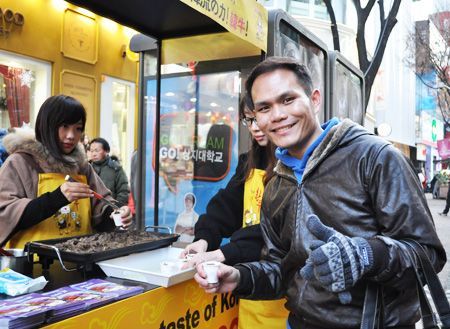
A foreign tourist tastes hanwoo bulgogi, marinated beef with soy sauce, in Myeong-dong, downtown Seoul, on Dec. 15. 2012. The Hanwoo Board has been promoting homegrown beef to foreign visitors to counter the consumption slump. / Courtesy of Hanwoo Board
Aggressive marketing at home and abroad
The Hanwoo Board has been implementing promotional campaigns abroad to help publicize hanwoo as high-quality, premium beef.
It has kicked off a global campaign dubbed “Power of Hallyu: Hanwoo,” over the past year to promote the excellence of Korean beef to non-Koreans.
“Despite the fact that hanwoo is tastier and more nutritious than American and Australian beef, it is not well known,” Kang said. “We would like to create the next hallyu boom through hanwoo.” According to him, hanwoo contains higher levels of oleic acid and other nutrients than American and Australian beef.
The board dispatched a group of campaigners to London during the Summer Olympics in July last year. They staged a number of cultural events to attract crowds and held a sampling event so non-Koreans could taste beef jerky made from hanwoo.
“We received positive feedback from those trying the jerky. In particular, we got fervent responses from children. Hanwoo jerky and other processed items have the market potential to be sold as a snack to young people abroad,” Kang said.
The board also signed a cooperation agreement with the Korean American Chamber of Commerce in Greater of New York last November to jointly support the globalization of hanwoo.
“Korean business leaders in New York promised to publicize hanwoo among both ethnic Korean residents and Americans,” Kang said. “We plan to sign accords with more Korean business associations across the United States. We will also organize hanwoo sampling events for foreign journalists here, encouraging them to write about how delicious and nutritious it is.”
The chairman then said the board will actively promote Korean beef among nearly 1.2 million foreigners residing in the country.
“We haven’t carried out any public relations events targeting non-Korean residents here. But this year, we plan to organize a wide range of promotional events for them so that they can become goodwill ambassadors,” he said. “We will first invite low-income multicultural families to try hanwoo, so they will realize that hanwoo tastes better than imported beef.”
The board has been sponsoring the nonverbal comedy performance, “Nanta,” popular among foreign tourists, in which actors and actresses make a variety of dishes with hanwoo.
“At least 1,000 non-Koreans watch the performance each day at the theater in Myeong-dong, downtown Seoul. After the show, we set up a booth where foreigners can sample several hanwoo dishes. They always form a long line waiting to taste the dishes.”
The chairman also said the board will produce leaflets containing a list of 200 hanwoo festivals and restaurants across the nation.
“We will soon make and distribute the leaflets in English, Chinese and Japanese,” he said. “In cooperation with travel agencies, we will introduce a tour package for those wanting to eat hanwoo and learn more about it.”
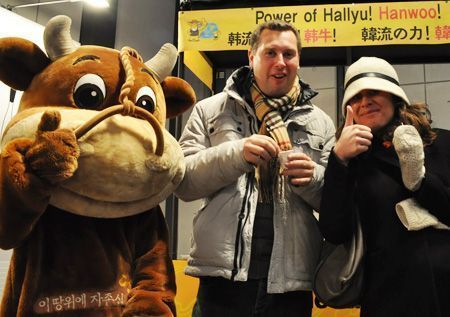
A foreign couple tastes hanwoo bulgogi after performance of comedy show, “Nanta,” at a theater in Myeong-dong on Dec. 21, 2012.
Boosting domestic consumption
Kang expressed concerns over the hanwoo industry, urging the government to extend full support to struggling hanwoo farms.
“To globalize hanwoo, hanwoo providers first need to make money. But many are struggling financially due to rising production costs and falling sales prices,” he said. “Due to the worsening profitability, the number of farms raising hanwoo fell to 130,000 in 2012 from 170,000 in 2010.”
Hanwoo farms have been hit hard by soaring prices of animal feed and other costs. But cattle prices have declined sharply over the past few years because of sluggish consumption and larger imports of cheaper foreign beef.
“Cattle farms these days sell cattle at prices lower than production costs. Hanwoo retail prices should decline, accordingly. But they don’t because of the inefficient, multi-layer distribution structure. This has dampened hanwoo consumption amid the continuing economic downturn,” Kang said.
He said the government needs to offer financial incentives to encourage hanwoo farms to reduce the number of cattle. It should also make it more affordable for consumers to eat hanwoo by removing the middle men.
The chairman said the board will open more markets where hanwoo producers and consumers can meet directly, enabling the latter to buy beef at much lower prices than in conventional retail stores.
“To boost consumer confidence about hanwoo, we will spend more money this year to clamp down on butchers and restaurants who sell imported beef as hanwoo,” Kang said. “We will also implement a wide range of marketing activities to increase hanwoo consumption.”