How mobile technology can transform your business
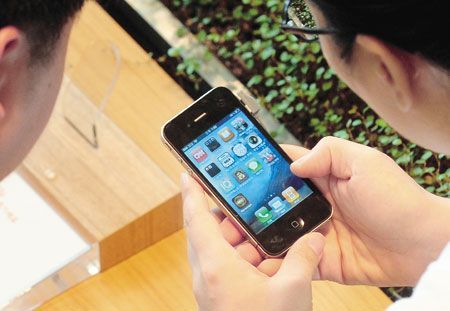
A mobile health check should be to answer following fundamental question: “Can consumers and employees engage with the company through the device of their choosing, at a time and place of their determination, and come away from the experience satisfied and having accomplished what they set out to do?” / Korea Times file

Lee Kyoung-jin is a partner and managing director of The Boston Consulting Group.
By Lee Kyoung-jin
From Lewis Carroll’s novel, “Through the Looking-Glass and What Alice Found There,” Alice wonders what the world is like on the other side of a mirror’s reflection. She steps through the mirror and finds a totally different world. Companies these days might feel that they stand at Alice’s glass regarding mobile-driven environment.
This year, mobile access will overtake fixed-line access as the world’s primary way of going online. Four out of five broadband connections will be mobile by 2015. For a large and growing share of users around the world, the Internet will be an entirely mobile experience.
Numerous factors are converging to give mobile the transformative capabilities, scale, and reach. Today, people use mobile devices with computer-equivalent power and memory, increasingly ubiquitous network coverage, the ability to apply “context”—location and social networks—to generate value, and all manner of wireless connectivity, including Wi-Fi, LTE, Bluetooth, and near field communications. Smartphone and tablet have numerous functionalities akin to that of a Swiss army knife. Then there are countless numbers of apps spinning out of the vibrant mobile app ecosystems. In addition, “machine to machine” communications, including smart metering applications, the connected car, and the connected digital home, are being aggressively pursued by many of the world’s leading companies.
Combine these technical factors with two demographic realities, and the full scope of mobile’s impact begins to emerge. One demographic shift is the advent of a big new generation of consumers into the economies of the developed world: the 16- to 34-year-old Millennials, who outnumber the baby boomers and have a far greater degree of technical sophistication, appetite for consumption, and desire to be connected. Their primary experience with the Internet is mobile.
The other demographic fact is that the vast majority of the world’s population lives in developing markets where the Internet is just taking hold and where the Internet experience is mostly mobile. As the next billion consumers come online, it will be through the screen of an Internet-enabled smartphone or feature phone.
The realization of this scale and reach is beginning to drive new waves of innovation in companies and economies around the world. There’s big money at stake. The aggregate Internet economy in the G 20 nations will reach $4.2 trillion by 2016 and contribute 5.3 percent of GDP. An increasing share of this contribution will come from products and services accessed through mobile devices. The worldwide digital-services ecosystem alone will reach $1 trillion in revenues by 2015.
It is irresistible for most companies to assess their readiness by understanding the mobile driven environment and putting their businesses through a mobile health check to have all the capabilities they need to engage customers and employees in the new environment.
Mobile models take shape: structure of “stack”
Three main models are emerging for mobile’s uptake and integration into the global economy. BCG calls them collaborative, competitive, and greenfield. Although the three models differ in how players at various levels choose to compete, each one can be viewed as a “stack” — a set of layered software and hardware that work together to drive a smartphone or other device. Each layer of the stack is made up of competitors and collaborators, interacting among themselves and with the other layers to provide services to the layers above and ultimately to the end user or consumer.
At the top of the stack stand consumers who create, consume, and share content, and use all manner of applications and services, which content developers, software companies, social networks, and others create. The next layer belongs to the enablement platforms that handle everything from hosting to security to billing and payment.
The mobile operating systems that power smartphones and tablets occupy their own layer of the stack. Mobile devices, manufactured and marketed by original equipment manufacturers in partnership with the companies providing the operating systems and sometimes also with telcos, occupy the next layer. Next come the mobile and broadband service providers facilitating network access for users. At the foundation of the mobile stack is the physical infrastructure—the mobile and backbone networks that provide the necessary connectivity and bandwidth, without which the stack could not function.
How varying players collaborate and compete up and down the stack, for capital as well as customers, defines the industry structure. In Japan, market leader NTT Docomo has driven development of a model based around partnerships and acquisitions to create a vertically integrated ecosystem that provides services and experiences that users will value. It sees itself as an “integrated service company placing mobile at the core” that intends to “drive innovation through the convergence of mobile with other industries and services, thereby creating new values and markets.”
In the United States and elsewhere, telcos, cable operators, and others are jockeying for position in their own layer of the stack, trying to protect existing businesses and revenue streams, at the same time as they battle to move up into other layers. Meanwhile, two major ecosystems have taken hold, driven by Apple’s iOS and Google’s Android. They are enabling fierce development of the apps and software services that are fueling much of mobile’s rapid rise.
China, the world’s biggest market, has developed a hybrid model that is driven by the country’s big operators, such as China Mobile, with aggressive competition among app, content, and service providers — domestic and international — in the upper layers. The stack in many emerging markets, such as India and Africa, is still under construction. Not only is the infrastructure being built out, but the nature of competition and collaboration among players is a work in progress as well.
Mobile health check for companies
The challenges that mobile presents to companies are no less complex. Not only is mobile’s development playing out in varying ways in different regions, but users like to interact with companies using multiple devices. The competition among operators and operating systems adds another layer of intricacy. Further, mobile is one of many digital capabilities that businesses need to build—others include cloud computing, digital marketing, social media, and big data—and they are all highly interdependent.
Management teams should simplify the nature of the challenge by putting their businesses through a “mobile health check.” A mobile health check should be to answer following fundamental question: “Can consumers and employees engage with the company through the device of their choosing, at a time and place of their determination, and come away from the experience satisfied and having accomplished what they set out to do?”
Just as the users of the early Macintosh or Windows computers could hardly imagine the capabilities of an exponentially more powerful, wireless handheld device developed only three decades later, none of us can envision the devices our children will be using a few decades from now—or how or for what. This doesn’t mean we shouldn’t try. During her adventure through the looking glass, Alice faces impossible things, but to set a goal to make it a reality. As consumers revel in the “impossible” simplicity of the world at their fingertips, businesses face the complexity of keeping up with the rapid pace of innovation. Those that want to shape the future for their companies, rather than watch from the sidelines as it accelerates past them, will grab hold of the complexity and determine how to make it work for them now.