MBA made career change possible
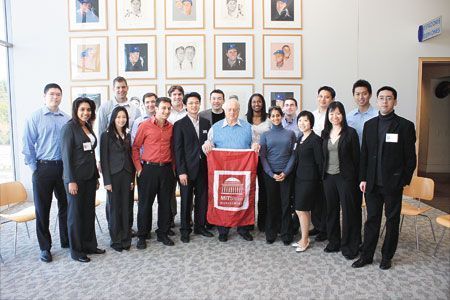
Daniel Sung-jin Kim, fourth from left in front row, poses with Los Angeles Dodgers former manager Tommy Lasorda, center, and classmates during the Sloan Entertainment and Media Trek group’s visit to the baseball club in California, Jan. 7, 2008. / Courtesy of Daniel Sung-jin Kim
Daniel Sung Jin Kim, strategic partner lead at Google Korea, graduated from the Massachusetts Institute of Technology (MIT) Sloan School of Management in 2008.
The former journalist at The Korea Times talks about how studying at Sloan helped shift his career to a business development role at the world’s most sought-after IT firm.
Q Why did you decide to do an MBA?
A I worked as a business reporter for a little over five years from 2001. I enjoyed working as a journalist, but after a few years, inspired by many CEOs that I interviewed, desired to do something that adds value to society and the economy than just conveying news. Reporters generally are generalists, but I wanted to become a specialist. I considered various paths including film, law and business, and came to the conclusion that an MBA would be the best option to make the most out of my experience.
Q Why did you choose the MIT Sloan School of Management?
A I received multiple offers from top business schools in the U.S., including a scholarship offer from the Fuqua School of Business, Duke University. I chose MIT because Sloan is among the top five business schools in the U.S. and MIT is the world’s top engineering school, renowned for innovative technologies. Also I initially wanted to start my own business after graduation, and Boston, or New England, is one of the best regions in the U.S., second to Silicon Valley to start a new business. MIT has an excellent business plan contest called MIT $100K, and it was a super exciting experience to participate in it.
Q How did you prepare for admissions?
A I had to prepare for admissions while working full-time. One teacher at a cram school stressed that students have to study at least eight hours a day in order to get admissions to the 10 best business schools. I did spend around eight hours a day on preparation — I studied early in the morning, worked in the day and went to a cram school in the evening. Prepping for B-school is all about time management and setting priorities right.
There are four components of successfully getting into top B-schools — in order of importance, essays and resume, recommendations, GMAT/TOEFL scores and undergraduate transcript.
The essay should show your career path, so you should manage your experiences well in order to write a good essay. As a reporter, there weren’t many opportunities to demonstrate leadership, so I volunteered as a deputy team leader of the task force for the official newspaper for APEC Busan back in November 2005.
Writing essays is about packaging, marketing and selling yourself, but no lies. It took me six months to write an essay. The whole process gave me an opportunity to look back on myself and rethink my long-term goal. When I reviewed my strengths, weaknesses, leadership and teamwork, I realized that my ideas for the future were not as clear as I first thought. The opportunity to write an essay helped me to look back on myself and set my career plan straight, and that was an important turning point in my life.
For recommendations, I asked the schools for advice. I learned that receiving recommendations from those who know me well and are fluent in English are better than getting them from high-ranking government officials or the famous who don’t really know you.
Q How did the degree help your career?
A Although I initially wanted to launch a startup, I felt I was not prepared in the final semester of the MBA program.
Many MBA graduates get recruited by consulting firms or investment banks. Students often have this illusion that they should work in corporate strategy, not in sales or marketing divisions. I also had the illusion, and applied only to corporate strategy divisions in U.S. firms. Some companies suggested that I would be better at marketing or public relations, judging by my experiences. Switching job to a completely different industry and function in the U.S. is extremely difficult, and I didn’t know that back then. I actually had applied to Google in the U.S. while I was in school, but didn’t get the job back then.
Q What were the challenges during the program?
A As a journalist, I was good at one-on-one communication, but wasn’t used to speaking or making a presentation in front of the mass. I had to speak up in the class to get recognized, but it wasn’t easy at the beginning. At MIT, I was torn down, crumbled and rebuilt.
The first semester was extremely challenging, and American and European classmates didn’t show a hint of struggling. At MIT, a class divides into several cohorts, and I was the only Asian in mine. Students from the same cohort had a dinner right before graduation, and I asked them if they ever had a hard time. Surprisingly, most of them said they did, but just strived not to let others know. Back in the first semester, I thought I was one of the few that struggled among the world’s brightest minds, making my semester even tougher.
MIT has a great counseling program. You hear students at KAIST commit suicide. MIT surely has a lot of smart people under enormous pressure, and MIT has developed an effective program over time. Such a counseling system was super helpful.
Q Did you do a summer internship?
A I was interested in working in the media/entertainment industry, so I applied to corporate strategy divisions of various top entertainment firms in the U.S.
However, a career change was not easy for even getting an internship. I landed a summer internship program at CJ Entertainment in 2008. There, I realized that what I really wanted to do may not be what I was best at. I wanted to move to the IT industry, but there were some personal matters upon graduation so I had to move back to Korea. After graduation, I worked at the product strategy division of LG Display, and later moved onto Google Korea. LG Display, formerly LG Philips LCD, was a good place for me to make a“soft landing” after an MBA since I covered LCD industries before and I was familiar with the industry and technology. After all, I made a detour. An MBA did help me a lot to switch careers to now at Google, where I originally wanted to be back when I was in Sloan.
Q How’s the Sloan’s alumni network in Korea?
A At Sloan, I focused most on networking. Learning is important but good curriculums are also available here in Korea and B-schools in Asia. Building a network or becoming friends with smart people from all over the world, especially from China, Japan and South Asia, is crucial, I thought.
Sloan accepts around 350 students a year. That’s a lot less than the number of students accepted by Wharton or HBS at more than a thousand each, so we have a smaller alumni network. MIT, however, has an alumni website that connects all the graduates regardless of their majors. I once sent cold-call emails to alumni, and they replied. MIT has a strong alumni network.
Some of the well-known Korean Sloan alumni include Hyundai Card CEO Ted Chung, GE Korea President Khang Sung-wook and Media Will CEO Joo Won-seok. In Korea, the alumni of the business schools of HBS, Stanford and MIT meet up once a year. It’s a great networking event.
Q What’s your advice for the future applicants?
A My wife also plans to pursue an MBA, and I often tell her that people perform beyond their capacity when they are faced with a dead end. Those who are desperate to get an MBA will get admitted to top business schools. People, who want to study because they are fed up with their current job or boss or teammates they work with, may not get the most out of the MBA program.
Applicants to MBA programs often say that they want to get into top 10 B-Schools rather than what they want to do after graduation. Mickey Kim, a well-known Korean working at Google in Mountain View, Calif., studied an MBA at HAAS, University of California, Berkeley. When he pursued an MBA, he had a clear goal of getting into Google.
Take some time to think about which direction you are heading to and to examine yourself, and why you’re trying to pursue an MBA.