Sookmyung MBA focuses on hospitality

Sookmyung MBA instructor Lee Hee-jung lectures during the Principles of Hospitality Management class, Thursday. SHBS introduced several experience-oriented programs, including presentation sessions and case studies. / Korea Times photo by Yoon Sung-won
By Yoon Sung-won
“Busan has plenty of recommendable restaurants. But most of them lack proper promotional strategies. That is why I believe the city’s policymakers and business owners should put more stress on advertizing.” This is what Ryan Phillips, an international student from Texas, the U.S., said in a presentation session of “Principles of Hospitality Management” class at Sookmyung Women’s University Hospitality Business School (SHBS), Thursday afternoon.
Located in central Seoul, SHBS focuses on training experts in the hospitality industry.
In the class presided by MBA instructor Lee Hee-jung, four groups of students seemed more than eager to deliver presentations. The day’s topic was “how to attract more tourists to Busan.” Phillips, who said he is interested in the culinary industry using home-grown ingredients, chose the partnership with a globally-renowned culinary educational institution as one of the biggest merits of SHBS.
To provide a world-class culinary education, SHBS developed a partnership with the renowned “Le Cordon Bleu.”
Le Cordon Bleu, which means “the Blue Ribbon” in French, is the world’s largest hospitality education institution. Established in 1895, it focuses on the culinary arts and hospitality management.
Thanks to the partnership, students receive both the Le Cordon Bleu Hospitality MBA certificate and Sookmyung Women’s University MBA degree. Also, students automatically join Cordon Bleu Global Community through which they can network with its alumni worldwide.
“I think both the Le Cordon Bleu HMBA certificate and Sookmyung B-school degree will certify my qualification better when I get a job in the global culinary industry,” the Texan student told The Korea Times.
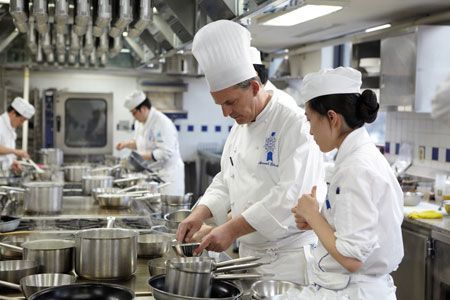
Students attend a culinary class at Le Cordon Bleu’s cooking facility on Jan. 23. Sookmyung HMBA arrange cuisine and pastry lessons at the globally-renowned culinary educational institution each semester. / Courtesy of SHBS
At the end of each team’s presentation, instructor Lee asked the presenters sharp questions. These are designed to teach students how to defend their ideas when they want to persuade those who are against them, according to Lee.
“In situations like this, you should be able to provide evidence, like statistics, to be more persuasive,” said the instructor to her students.
After the five-day workweek was officially introduced in Korea nine years ago, people steadily began to have more time to enjoy leisure and entertainment. Also, the number of foreign tourists coming to spend their holidays here has skyrocketed in recent years, leading to a qualitative and quantitative expansion of Korea’s hospitality industry.
In spite of the exploding demand in the industry, competent professional managers who specialized in hospitality management are still rare in Korea. SHBS was established in 2007 to meet such a need.
In an effort to globalize the HMBA, most classes are conducted in English. All day-time classes and 50 percent of night-time classes are taught in English. It explains why the program has attracted many foreign students.
“Ten of the 14 students in the day-time class come from other countries, whereas most of the night-time class students are those who currently work in the hospitality industry,” said Kim Sung-chae, general manager at SHBS. To improve the quality of lectures, the maximum number of students is limited to 20 each, for both the day-time and night-time classes, according to the business school.
Foreign students in SHBS said the future of the hospitality industry worldwide is bright.
“I think in-depth knowledge is becoming more important because the hospitality industry is growing everywhere in the world. I have learned how to manage a hospitality business in SHBS. Now I’m looking forward to adapting what I’ve learned when I go back to my homeland,” Martha, a student from Kenya said.
The HMBA also boasts a special lecture program called “Trend Workshop,” which is arranged to blend up principles and hands-on field experiences. More than five lectures take place each semester. This special lecture series is designed to invite industry executives to address the students.
So far, several service industry executives including Walkerhill executive director Bae Sun-kyung have visited SHBS to give lectures.
Some might worry that concentration in hospitality management will likely lead to missing other kinds of subjects that ordinary MBAs teach. But head professor Son Byung-gyu, director of SHBS, said that the courses are designed to include accounting, finance, human resources, marketing, management and strategy, as well as hospitality-related subjects.
“When you construct a building, the foundations are the most important regardless of the type of building. Likewise, SHBS’s curriculum is designed to provide a firm basis of knowledge in business management,” the director said. “Based on the knowledge, students can choose how to specialize in each segment of the service industry. The choice solely depends on the students’ interest.”
The head professor also mentioned the direction SHBS is heading in.
“Our ultimate goal is to train competitive professionals for the global hospitality industry. SHBS will keep improving itself in the future by providing more and better experience-oriented classes.”