Six rules of persuasion
.jpg?w=728)
Robert Cialdini, Kim Hoh, Professor of Cialdini Method Arizona State University Certified Trainer
Kim Hoh explains Cialdini’s methods to influence people
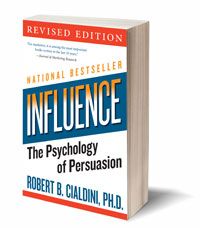
“Influence: The Psychology of Persuasion” by Robert Cialdini
By Kim Da-ye
In 2009, the Educational Broadcasting System aired a popular documentary called, “The Secrets of Persuasion.” The five-part program started with a woman posing as a volunteer and asking office workers if they could join a community project of delivering coal briquettes to the needy every Saturday for eight weeks. Most said no. She then suggested that they do it for just a week. The respondents accepted the second deal, saying, “One week would be okay.”
The woman asked another group of office workers if they could volunteer for one Saturday. Most of this other group rejected the request. One said, “I always rest on Saturdays.” Another said, “I am busy on weekends.”
What made the difference between the two groups? The obvious answer is that the first group felt bad that they rejected the first request, so they accepted a relatively simple one.
This is an example of how many people consciously or unconsciously ask for more initially and then subsequently ask for less in order to get what they really want.
Kim Hoh, the founder and head coach of the communications consultancy THE LAB h, says that there is more to the experiment.
It reveals a very fundamental principle of persuasion — the importance of creating a context before trying to influence someone.
In order to convince people to sign up for one Saturday, the woman set a context of asking a less reasonable favor and having it rejected. No context exists in the second part of the experiment.
Kim is one of two Cialdini Method Certified Trainers in Asia. Robert Cialdini, renowned psychology professor at Arizona State University, has researched the importance of context in persuasion techniques.
Kim, in fact, advised the broadcasting channel in the early stages of developing the documentary.
Kim makes the concept of context easy to understand with a basic scientific experiment. When you have your right hand in cold water and the left hand in hot water, and then you dip both in lukewarm water, the right hand will feel hot and the left one will feel cool.
What truly matters here is knowing how to create a context — a highly useful skill in business. Kim emphasizes that persuasion is not about what you persuade people to do for but how you persuade them.
The communications expert shared with The Korea Times’ Business Focus how to create a context on different occasions at work. Business Focus attended Kim’s quarterly workshop and interviewed him to find out more about Cialdini’s six principles of persuasion — the secrets to how to effectively influence others and get what you want. Each principle is illustrated below.
Reciprocity
When Ahn Cheol-soo, the founder of antivirus software firm AhnLab, last month announced his candidacy for a National Assembly seat representing the Nowon district of Seoul in the upcoming by-election, two men, Park Won-soon and Moon Jae-in, were the first to welcome his decision.
Ahn had made a concession to both men in the past. In 2011, he backed off in Seoul’s mayoral election, endorsing Park, the current mayor of Seoul. During the presidential election campaign, he again withdrew his candidacy, making Moon a single opposition candidate.
According to Cialdini’s first principle of persuasion, the concept of reciprocity, making a concession, is a powerful way of setting a context. “Right after your request has been rejected, you get a moment of power,” Kim said. “In that moment, you are highly likely to get what you want if you make a reasonable request.”
The principle of reciprocity is based on the human nature to repay a favor. Cialdini puts it simply, “Give what you want to receive.” The key word of this principle is “before” — you should proactively help the person whom you hope to persuade in the future.
In business, gifts can be a useful tool. Kim said gifts should be meaningful to the people who receive them and should be unexpected. It sounds obvious, but most companies seem unaware of it.
Think of common gift sets sent out to business partners for the Lunar New Year and Chuseok. Kim said that these kinds of gifts can be easily forgotten and have little impact on the relationship. Kim does advise, however, that such gifts do have an impact on retirees, most of whom get disconnected from their colleagues and partners after retirement.
Consistency
The principle of consistency is based on the tendency to act in line with what they thought and said in the past. One example in Cialdini’s book, “Influence: The Psychology of Persuasion,” is a racetrack study that proves that people believe the same horse is more likely to win once they have bet money on it — the act of committing money.
The professor’s key advice is, “Make others’ commitments active, public and voluntary.”
In his article in the Harvard Business Review titled “Harnessing the Science of Persuasion,” he wrote, “If you supervise an employee who should submit reports on time, get that understanding in writing (a memo); make the commitment public (note colleague’s agreement with the memo); and link the commitment to the employee’s values (the impact of timely reports on team sprit).”
Kim adds that in order to encourage employees to put the plans they discussed in meetings into practice, the host of the meetings should ask participants to repeat what they are going to do and by when.
Another application of this principle is boosting attendance of important guests in a luncheon by asking them to choose the venue of the meeting or the menu.
Social proof
Social proof starts with the tendency for people to follow the majority or a large number of other people. But how can one use this principle for effective persuasion in business?
Kim brings up an example of doing a survey. He asks to think of a situation where you have to survey 200 employees in a week, and your boss tells you that the response rate should be over 60 percent.
On the first day, some 30 people responded, and the next day, only a half replied. On the third day, none did. You need to send out a follow-up email to convince the remaining people to respond. How can you encourage more people to participate using the principle of social proof?
Many supervisors would write in the email how few people have participated so far and how desperately the answers are needed. Kim said that in order to influence people with the principle of social proof, one should not highlight what others are doing wrong but what others are doing right.
Kim has many occasions to send out surveys because he asks for feedback after every workshop. In his follow-up email, he picks some positive responses and uses them to encourage others to do the same.
He writes, “As soon as the survey went out, many people responded by providing very detailed constructive feedback. I appreciate that. If you have not had a chance to comment yet, please do so by clicking on the link. It is a very short survey!”
Kim said that the next day, the response rate tripled from 23 to 69 percent.
Liking
Cialdini teaches that relationship, a context that exists before persuasion, matters more than the logic of persuasion. The principle of liking is closely related to this. The professor’s message is, “To influence people, win friends.” One can build relationships with business partners through discovering common interests or similarities on informal occasions. Furthermore, a natural, honest compliment can improve that friendly feeling further.
Kim brings up an example of U.S. President Barack Obama choosing Woo Lae Oak, a Korean restaurant in Virginia near Washington D.C., as a venue for an informal dinner with former President Lee Myung-bak during Lee’s visit to the U.S.
Whether or not Obama truly likes Korean food is unknown, but by choosing a Korean restaurant, he indeed tried to find similarities between himself and Lee and indirectly compliment “hansik” or Korean food, which the Korean first lady was devoted to globalizing. Furthermore, that dinner was not on the official schedule of Lee’s visit.
Authority
People tend to follow experts’ advice, so you have to be a person of authority in order to influence. But you don’t need to be a well-known scholar or a celebrity to do so.
One can start with dressing up for the occasion. Cialdini cites in his book “Influence” research conducted in Texas. A man crossed the street jaywalking repeatedly — half of the instances in a business suit and tie and the other half in shirt and trousers. The number of people who jaywalked along with the man in the suit and tie was three and a half times as great as the number who followed the same man in shirt and trousers.
Authority isn’t all about trying to sound and look smart. Kim says that credibility boosts one’s authority, and it forms from the opposite of what we think is authority — admitting your own weakness or faults. Kim brings up an example of actress Kim Hye-soo who recently admitted that she plagiarized while writing her master’s thesis and promised to return her degree. Because of her admission, she is no longer a subject of controversy, but is highly popular in her new soap opera, “The Queen of the Office.”
Scarcity
People want to have what others do not. That’s why limited editions of designer goods sell briskly. For example, at work, scarcity in the form of exclusive information can help create a context for effective persuasion.
Cialdini cites an experiment done by his student who became a successful owner of a beef-import company. In the experiment, the student’s company gave one group of clients a standard presentation on its beef products. The second group was given the same presentation plus the information that the beef imports would be scarce in the upcoming months. The third group was given the same presentation as the second one, plus an extra comment that the news about the scarce beef imports was for exclusive clients. According to Cialdini’s book, the second group ordered twice as much beef as the first did, and the third group did six times as much.
Another real-life application of the scarcity principle is highlighting the losses of not buying a product rather than the gains from buying a product. Doing so is important because people react more sensitively to losses than gains.
Kim cites a study by Choi In-cheol, a psychology professor at Seoul National University. According to Choi’s book “Frame,” people are more likely to pay with cash when they are told to pay 1,000 won extra with a credit card payment than when they are offered a 1,000 won discount for paying with cash.