Outlet pioneer

Hong Seong-yeol, CEO of Mario Outlet / Korea Times photo by Shim Hyun-chul
Mario Outlet seeks to become shopping hub for foreign tourists
By Lee Hyo-sik
Nobody believed Hong Seong-yeol, CEO of Mario Outlet, when he said 13 years ago that the Guro Industrial Complex in southwestern Seoul would transform into a booming fashion town. However, just as Hong predicted, the once sleepy industrial district has become a major shopping center. Budget-conscious shoppers are now flocking to Mario Outlet and other large-scale outlet malls there.
“Mario Outlet started as a knitwear company in 1985. I realized that the biggest difficulty with the fashion business was how to deal with inventory,” Hong said in an interview with The Korea Times. “I thought outlet malls, which were already common in the United States and other foreign countries at the time, were the answer to the problem. So I decided to introduce the concept of outlet stores to Korea.”
He said outlet stores are a win-win solution for both producers and consumers. “Shoppers can buy high-quality goods at a discount, while companies can dispose of inventory and still turn a profit.”
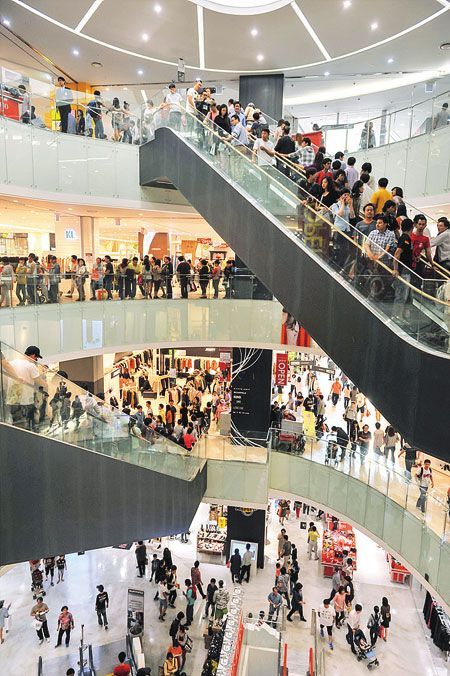
Shoppers pack Mario Outlet’s No. 3 store in southwestern Seoul, which opened in September 2012. / Courtesy of Mario Outlet
The CEO said he decided to open outlets in the Guro Industrial Complex because of its geographical advantages and the low cost of land. “The complex was once a booming industrial district filled with hundreds of thousands of factory workers,” he said. “But it became a ghost town after most plants went bankrupt in 1997 and 1998. I wanted to turn the area into a booming fashion center by establishing outlet malls.”
Mario opened its first store in July 2001 and its second in August 2008. In September last year, the retailer launched its third store, becoming Asia’s largest outlet mall in terms of floor space.
“The business environment of the retail industry has changed dramatically over the past decade,” Hong said. “But our principle has never changed; we offer customers high-quality fashion brand products at reasonable prices. This is our most important success factor and we have gained the trust of hundreds of thousands of price-conscious shoppers.”
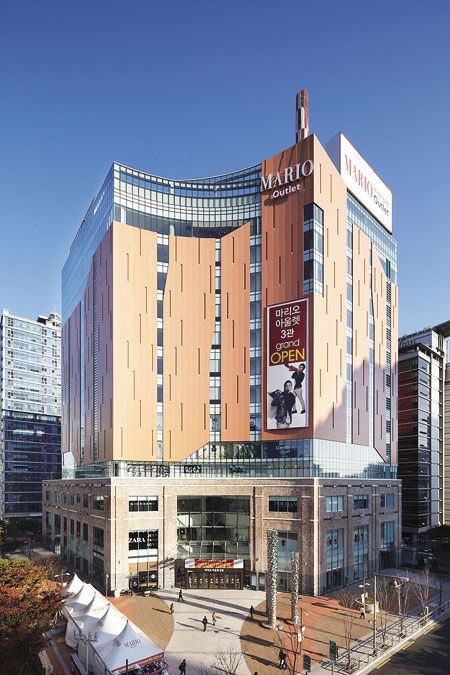
Mario Outlet’s No. 3 Store
Mario Outlet has also become popular thanks to its proximity to central Seoul, he said. Shoppers can easily get to the mall via subway, taxi or bus, whereas they have to drive for hours to visit outlet malls operated by department stores in rural areas.
“With the prolonged economic downturn, a growing number of consumers are shunning department stores and instead are heading to outlet malls in search of low-priced goods. We expect more and more shoppers will visit our stores in the coming years,” the CEO said.
Attracting foreign tourists
Mario Outlet has been seeking to draw more Chinese and other foreign tourists interested in buying clothes, cosmetics and other merchandise while they are in Korea.
“These days, Korean customers have become more frugal due to the bad economy. But Chinese tourists are big spenders snatching up brand products worth thousands of dollars at a time,” Hong said. “Our 500 brand shops offer a wide range of both imported and made-in-Korea products that are popular among foreign visitors. The merchandise ranges from clothes and other fashion items, to luxury goods and cosmetics. They can buy them at a discount of up to 80 percent.”
Mario also offers tailor-made customer services targeting Chinese and other non-Korean shoppers. The intention is to turn Guro into a mainstream fashion district, rivaling Dongdaemun and Myeong-dong.
Dongdaemun is a wholesalers’ market, the CEO said, adding that fashion shop owners, both Koreans and non-Koreans, usually go there to purchase clothes and other items in bulk, which they then sell at retail prices.
“In Myeong-dong, shoppers encounter mostly cosmetics and SPA (specialty retailer of private label apparel) brand stores. But at Mario Outlet, they can buy high-quality brand carryover products at discounted prices. When foreign tourists get to know more about us, they will come and do most of their shopping at our stores,” he said.
According to Hong, foreign shoppers can pay in dollars and other foreign currencies, and can easily get a wealth of shopping information through handbills written in English, Japanese and Chinese. The outlet also makes customer announcements in several foreign languages to better inform non-Korean shoppers about bargains and other shopping-related matters.
“We have been carrying out marketing campaigns in China and Japan in cooperation with the Korea Tourism Organization (KTO). As a result, the number of foreign customers has surged by over 100 percent each year over the past few years. We will continue to strengthen our ties with the KTO and travel agencies to implement more aggressive promotional activities overseas,” the CEO said.
According to the KTO, the number of foreigners entering the country reached 11.14 million in 2012, up from 9.79 million in 2011. The figure is expected to reach 12 million this year.
Despite the foreign interest, Hong cautioned about expanding overseas, saying it is too early for Mario to establish ‘Korean-style’ outlet malls in China or Southeast Asia.
“Many entities have asked me to set up and operate outlet malls in Asia where Korean pop culture and products are enormously popular. But I do not think we are ready to do business overseas. We must first solidify our position in the domestic outlet industry,” Hong said.
Mario plans to complete the enlargement of its first store by September. It expects to earn 500 billion won ($455 million) in sales this year. The retailer has expanded its food courts and opened premium restaurants and other facilities, enabling customers to enjoy a more pleasant shopping experience.
Competition with Lotte, Shinsegae
Hong expressed concern over the entry of large department store chains into the outlet sector, stressing that Mario has to work hard to maintain its competitive edge.
“I think it is wrong of Lotte and Shinsegae to operate outlets because the sector will soon reach a saturation point even without them. If they continue to expand into the outlet business, they will suffer from a dwindling bottom line,” the CEO said. “Things will certainly become more difficult for Mario as the retail giants expand their presence. But we will continue what we do best; provide high-quality brand goods at low prices.”
He then complained about large retailers’ attempts to recruit Mario employees by offering higher salaries and more generous benefits.
“We train new employees for three months. Through our intensive training program, they become competent, talented retail specialists. But large retailers are eager to poach our trained workers. I have put up with this for years but I must do something to stop them from stealing our staff,” the CEO said.
People are the most valuable asset in the retail industry, Hong said. “I put top priorities on honesty and communication when recruiting new Mario members. If jobseekers are not competent, they can be trained. But if they are not honest or are reluctant to communicate with others, they will hurt the organization. I always try to figure out whether they are honest and open-minded.”
Selling premium fashion brands and other consumer items is important, Hong said, but what matters more is that Mario satisfies its customers by providing top-notch services.
In order to capitalize on the booming online shopping trend and better serve its 600,000 members, the retailer began operating a cyber shopping mall last September.
“When consumers are too busy to visit our stores, they can simply log onto our online mall and purchase products at the same low prices. We will continue to expand the list of items we offer online to better serve our member and non-member customers,” Hong said.
Mario has also been implementing a wide range of corporate social responsibility activities to give something back to local communities.
“We are proud of playing a key role in turning the Guro complex into a fashion town. But we could not have done it without support from local communities,” the CEO said. “Early last year, we opened a daycare center for children of working parents residing in the area. We also give priority to residents when we have a job opening.”
Mario has also been helping to financially support low-income families and seniors living alone.