Hanyang fosters healthcare managers
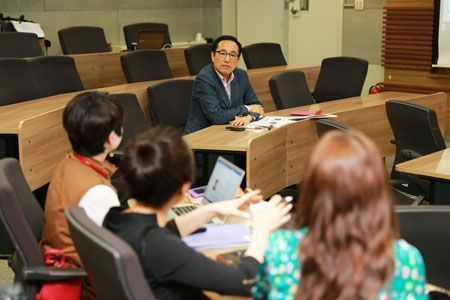
Suh Chang-jin, left, the head professor, holds a discussion with students during a Global Healthcare Management class at Hanyang University, Wednesday. / Korea Times photo by Yoon Sung-won
By Yoon Sung-won
Practicing medicine for patients is one of the noblest human acts that can save lives. It requires a considerable effort in accumulating skills and expertise. But managing or running a medical institution is a different matter that requires a different type of knowledge, because it’s a business.
For healthcare workers who seek to improve their managerial capability, Hanyang University Business School (HUBS) runs an MBA course specialized in healthcare management. The Global Healthcare Management MBA, the first of its kind in Asia, trains business managers who understand the characteristics of global healthcare and the medical industry.
“The MBA course is designed to foster competent healthcare management experts and healthcare policy developers to better prepare for the dramatic changes in the global healthcare sector,” Suh Chang-jin, the head professor of the MBA course said. “We teach students how to effectively steer the healthcare industry amid ongoing globalization of the medical sector and rapidly graying Korean society.”
The MBA, established in 2008, is the only regular healthcare MBA program that has been approved by the Korean Association of Business Education Accreditation, an organization that certifies business educational institutions in Korea. In April 2010, it acquired certification from the Association to Advance Collegiate School of Business (AACSB), a globally-recognized business school certification body.
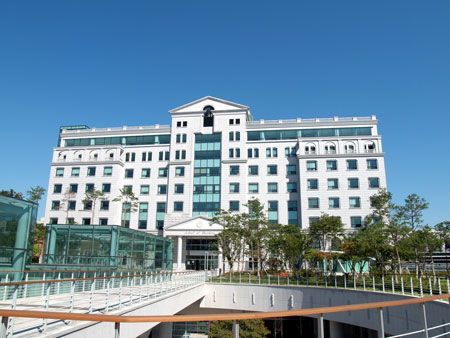
Hanyang University Business School building is located in Sungdong-gu, eastern Seoul. / Courtesy of HUBS
HUBS Global Healthcare Management MBA can be the perfect choice for those who are preparing for, or currently working in managerial posts at healthcare businesses and institutions. This is because the MBA’s biggest goal is to help students learn business management techniques and strategies that will promote the efficiency and competitiveness of medical institutions; and develop capability to analyze key factors of medical and healthcare policies to better formulate them, according to the professor.
“Under such goals, students are to ultimately acquire the ability to build their own know-how to drive medical institutions in the global market,” said Suh.
Its students consist of doctors and nurses from hospitals, researchers and pharmacists from pharmaceutical companies, as well as public relations managers at biotech firms and medical equipment companies. For instance, a doctor moving to an executive position at a multinational pharmaceutical enterprise, and a former nurse who was promoted to a managing position at a global medical consulting firm are among the alumni.
During the two-hour long “Understanding of Global Healthcare Services Management and Health Industry” class on Wednesday evening, students were eager to present and discuss creative ideas about healthcare industry issues. The day’s class was part of a three-week presentation session in which students presented individual projects prepared during the first half of the semester.
“If the paper-based system was the past, and paper-electronic system is the present, full-electronic system will be the future of medical records,” said Kwak Jang-jun, who made a presentation about electronic medical record systems in the class. Kwak works for GE Healthcare, a renowned global medical equipment company.
After Kwak’s presentation, students commented and questioned based on what they have experienced while working in the medical industry. Professor Suh led the discussion by adding sharp suggestions.
“Patient-tailored medical services and the application of big data analysis are the biggest issues in the global healthcare sector. And we should think further about how to successfully introduce these great ideas to reduce costs and to promote efficiency,” the professor advised the students.
Along with education itself, the students who come from various medical fields and positions establish human networks in the domestic and global healthcare sectors. These become a valuable asset for those who work in the medical sector where cooperation between businesses is crucial.
“One of the biggest merits of Hanyang healthcare management MBA is that students can acquire a strong human network among capable medical and healthcare experts,” Jeon Sang-jin, a student from Chong Kun Dang Pharmaceutical, a leading drug company here, said. “I’m sure the network will be very helpful when I go back to the work in the pharmaceutical sector.”
The healthcare management MBA has both daytime and nighttime classes and the size of these classes is between 20 to 30 students. During the two-year course, students attend healthcare management classes that cover a wide range of case studies, discussion sessions, workshops and seminars presided by healthcare experts, and field trips to superb medical institutions.
HUBS plans to introduce more programs that target foreign students and aims to extend its presence in the global healthcare market.
“We are developing programs that can contribute to bringing more foreign patients who visit Korea for medical purposes under the cooperation with the Higher-Education Management Institute, an attached institution of HUBS,” Kim Seung-chul, the associate dean of HUBS said. “Exchange student programs and dual degree courses with overseas B-schools are also planned in coming years to attract more foreign students.”