Ssangyong Motor revives night shift
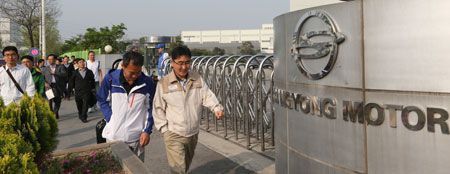
Ssangyong Motor workers come to work at the automaker’s plant in Pyeongtaek, Gyeonggi Province, Monday, the first day it revived a night shift for the first time in four years. / Yonhap
By Kim Tae-jong
Ssangyong Motor Monday revived an overnight shift on one of three assembly lines at its plant in Pyeongtaek, Gyeonggi Province, in order to meet growing demand, after reinstating in March some 460 workers who had been on unpaid leave for the past four years.
The overnight shift was abolished in 2008 because the automaker was put into court receivership in the wake of the global financial crisis.
The automaker said that the revival of the two shift system, although it is only adapted at the third assembly line, is a historic step toward full normalization at the firm.
“Now, we’re working hard, thinking this is our last chance,” said Ssangyong Motor CEO Lee Yoo-il. “We were able to revive the overnight shift, thanks to the efforts of all our executives and employees.”
The labor union and reinstated workers also said they are now concentrating on “one goal” ― early normalization of their business by increasing production volume and sales.
“Many things have been improved, and everything is new to me,” Kim Byung-mo, part of the painting section on the third assembly, said. “But I’m getting used to them, thanks to help from colleagues.”
The 48-year-old returned to work after having spent the past four years without being fully employed and facing various difficulties. He said he is really happy to be back and hopes the automaker will soon get back on track.
Kim is one of the 455 workers who took leave of absence without pay on condition that they would be reinstated when the firm’s business normalized, after the firm got rid of 2,600 workers. Of them, some 1,900 chose to retire and the rest were dismissed. The huge layoff sparked a 77-day strike at its Pyeongtaek factory, which disrupted the carmaker’s production for months.
The reinstated workers seemed to have difficulties in adjusting to work. So they received eight-week programs to better adjust to the work environment and two-week on-site training before they were dispatched to assembly lines.
Ssangyong operates three assembly lines at its Pyeongtaek plant. The first assembly line produces the Korando C, the second line produces the Chairman series, and the third line produces body-on-frame type SUVs such as the Rexton W, the Korando Sports and the Actyon as well as Kyron for overseas markets.
But the overnight shift has only been adopted by the third assembly line because demand is still too low to fully operate all the lines through the day and overnight shifts. Through the launch of the overnight shift, Ssangyong expects that its production volume will increase from 4,000 to 6,000 vehicles per month and to 74,000 vehicles per year.
“The firm has yet to swing into the black. Our full production capacity is 240,000 vehicles per year,” said CEO Lee. “To do that, we need to sell over 170,000 vehicles.”
It is now in a better shape since the arrival of its new Indian owner Mahindra & Mahindra but has yet to reach its peak performance. In 2012, the firm’s sales climbed 6.8 percent year-on-year to 120,717 vehicles, and it expects to sell about 150,000 vehicles this year.
Lee pins high hopes on the new car, named X100, which has been under development for launch in 2015, saying the Indian owner has provided the firm with full support for the project.
“The X100 will provide the firm with a chance for the turnaround. When it is launched, the first and second assembly lines will adopt the day and overnight shift system,” Lee said.