'Drug price control should be eased'
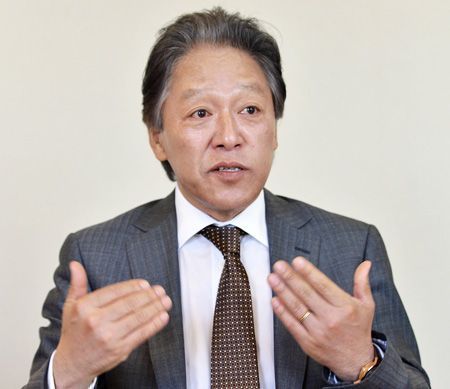
Kim Jin-ho, chairman of the Korean Research-Based Pharmaceutical Industry Association (KRPIA)
By Kim Rahn
The Korean government needs to ease its control over drug pricing to encourage domestic and foreign pharmaceutical firms’ investment, says the chief of a global pharmaceutical company association.
Kim Jin-ho, chairman of the Korean Research-Based Pharmaceutical Industry Association (KRPIA), said easing regulations and lifting the price ceiling for drugs will help the Park Geun-hye administration achieve its goal to make Korea one of the top seven countries in the pharmaceutical field.
He said Korea’s pharmaceutical market is not a free market but a regulated one, and this is unattractive to pharmaceutical companies.
“Companies invest when they can predict future profits and recover the money spent. In the Korean drug market, however, prices are not decided by the market but set at a low level by the government under the insurance system,” he said.
“If the government wants to encourage investment in the industry, a new policy is required. On one hand, the government will have to control drug prices to relieve people’s financial burdens, but on the other, it will have to ensure pharmaceutical firms’ growth. I know it will not be easy for the government to achieve both goals,” Kim said.
Kim, who is also the chief executive of GlaxoSmithKline (GSK) Korea, said new drugs are sold in Korea at very low prices, and that’s one of the factors preventing pharmaceutical firms’ investment. According to the KRPIA, the average prices of 77 new drugs approved here between 2007 and 2011 were only about 43 percent of those in 29 other OECD member states.
“With such low prices, pharmaceutical companies are not motivated to develop new drugs. This contradicts the government’s plan to foster the pharmaceutical industry,” he said.
Kim also said pricing policies in Korea change too often. “A new policy comes out even before assessing whether the previous policy was effective or not. This is another factor that makes Korea’s pharmaceutical market unpredictable.”
However, if these issues are resolved, Korea’s pharmaceutical industry has potential, said Kim, who is also GSK’s senior vice president in North Asia.
“So far, Europe and the U.S. have been the center of the pharmaceutical industry. But the paradigm is shifting toward the emerging market of Asia where the population is huge and the economic power is growing,” he said.
The chairman said diseases can differ according to ethnic groups. For example, hepatitis B is prevalent among Asians but not among Caucasians. “Because there are diseases and medicines that are specific to the emerging market of Asia, Korea has a significant opportunity to develop its pharmaceutical sector,” he said.
Kim said the ethnic similarity among Asians can help Asia’s pharmaceutical firms reduce time and money spent for developing new drugs.
“We say it takes $1 billion and 10 years for a company to develop a new drug, and the time and cost include those spent for failed experiments. If we can take advantage of others’ failures and experiences, we can save a lot of money and time. If a clinical trial in Korea is acknowledged in countries with similar ethnicity, such as China and Japan, companies in those countries can save time and money,” he said.
The KRPIA has 33 members, all of which are multinational companies, albeit it is not exclusive to this type of firm. Kim said he wants more domestic firms to join, and the association is open to all firms focused on R&D.
“Developing new drugs doesn’t end with development in the lab. It involves merchandising. Because Korean companies don’t have much global experience, it will be better for them to collaborate with foreign firms until they accumulate business know-how,” he said.
Kim said there will be many things the association can assist Korean firms on, from R&D cooperation to registration of new drugs with each country’s health authority.
“It will be a win-win business if Korean firms’ quality technology and global companies’ long-term experience are combined,” he said.
As to the recent safety problems of Janssen Korea, one of the KRPIA’s members, Kim said he agrees to the government’s move to control quality of medicines because public health matters the most.
However, he declined to comment directly about Janssen Korea’s alleged violations, saying it is a specific company’s issue, not that of the association.