Knowledge and the BRICs
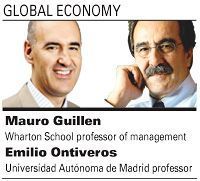
By Mauro Guillen and Emilio Ontiveros
We already knew that the global economy is no longer dominated by Europe, the United States, and Japan. Trade, investment and foreign exchange accumulation are now evenly divided between developed and emerging economies. This represents a key “global turning point,” to paraphrase the title of our recent book. As more and more countries join the BRICs in this transformation, the global economy will change forever.
The newest turning point has to do with knowledge and technology, which is no longer monopolized by the rich countries. The BRICs now account for about 20 percent of new scientific and technical publications in the world, and for about 25 percent of new patents. South Korea, considered to be the most important technological powerhouse among countries that made the transition from emerging to developed economy, adds 3 percent of articles and 6 percent of patents (about half as much as Japan).
The trends over time indicate a rapid increase in these figures, which clearly indicate that the global economy of the 21st century will be very, very different than that of the 20th century.
Knowledge creation through research and innovation is required for a country to become a member in the global economic aristocracy. They constitute the fundamental foundations for sustainable economic growth based on productivity increase and the development of new fields, industries, and activities.
The impact of this transformation on the various BRIC countries, however, is quite different, as reflected in a recent report by Thomson Reuters titled, Building BRICKs: Exploring the global research and innovation impact of Brazil, Russia, India, China and South Korea. In China and India one observes a widespread effect of knowledge creation and innovation through the economy, with strong increases in total factor productivity.
They are very much following a similar path to the one South Korea travelled in the 1980s and 90s. Russia and Brazil, however, are a different story. Both economies are seeing limited or no growth in total factor productivity.
Russia, perhaps more so than Brazil, has become an exporter of energy and minerals to the detriment of higher value-adding activities. In Brazil, one can find pockets of innovation in agriculture, biology and aerospace, but with few spillover effects over the rest of the economy.
The recipe for success in knowledge creation and innovation is rather simple. China and South Korea are excelling because they are allocating greater resources, as measured by gross expenditures on R&D.
It is important to note that both countries have very high expenditures not just by the government but also by companies, which contribute 75 percent of the total, compared to only 61 percent in Russia and 48 percent in Brazil. No country in the world without a private sector committed to R&D has been able to play a leading role in knowledge creation or innovation.
It is also important to note that the BRICs and South Korea are focusing their efforts not on traditional fields but in areas that lie at the intersection of several fields. Disciplinary boundaries in science and technology are blurring. The fact that they are relative newcomers to the big leagues of knowledge creation and innovation has made it easier for them to overcome barriers to interdisciplinary collaboration. If present trends continue into the future, the BRICs and South Korea are poised to account for a majority of scientific and technological activity in the world.
Mauro Guillen is a Professor at the Wharton School. Emilio Ontiveros is President of AFI and a Professor at Universidad Autónoma de Madrid. They are authors of Global Turning Points, just published by Cambridge University Press.