Yeungjin retains top in customer satisfaction
Lotte Hotel makes leap; Daelim Industrial plunges in annual survey of 288 entities
By Park Si-soo
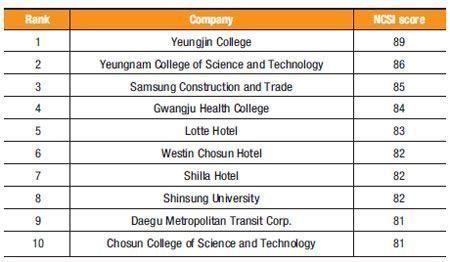
Yeungjin College ranked top for the eleventh consecutive year in the country’s flagship consumer satisfaction index for 2012.
Samsung Construction and Trade managed to maintain its ranking at third in the National Customer Satisfaction Index (NCSI) survey of 288 business entities disclosed by the state-backed Korea Productivity Center (KPC), Tuesday. Lotte Hotel made a dramatic leap to fifth from last year’s 10th, while Daelim Industrial’s ranking plummeted from fourth to 20th over the past year.
Among other entities included in the top 10 were Yeungnam College of Science and Technology, Gwangju Health College, the Westin Chosun Hotel, the Shilla Hotel, Shinsung University, Daegu Metropolitan Transit Corporation and Chosun College of Science and Technology.
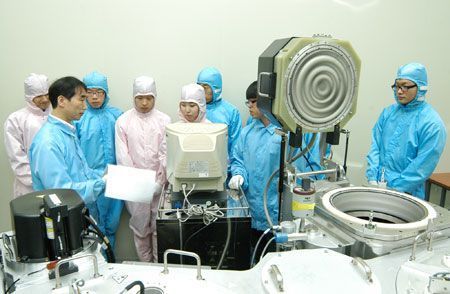
Students of Yeungjin College listen to an explanation on chip production during a field study at SK hynix in Icheon, Gyeonggi Province.
Over the past year, the KPC surveyed 77,149 citizens in the country’s five major cities of Seoul, Busan, Daegu, Daejeon and Gwangju in order to come up with the index.
To measure the satisfaction level for specific products or services, a total of three criteria were considered ㅡ customer expectation, perceived quality and perceived value with different weightings. The center regards 70 points out of 100 as the minimum level necessary to secure proper consumer satisfaction while those with lower scores will have to improve down the road.
“The average score for 2012 was 72.8, up 0.4 points from the previous year,” the KPC said in a statement. “Despite the country’s climate for business being adverse due to the protracted economic slowdown in the United States and Europe, domestic companies, universities and other entities were more aggressive in customer-oriented activities to improve satisfaction levels.”
Winners & losers
Yeungjin, the school dedicated to educating students based on a two-year curriculum, topped the list with 89 points. In the large-size passenger car sector, Hyundai Motor remained ahead of the curve with 77 points to be placed at 22nd, chased by Ssangyong at 33rd with 75 points, Kia Motors at 49th with 74 points and Renault Samsung at 52nd with 74.
In the refrigerator segment, Samsung Electronics was 43rd with 75 points while LG Electronics was ranked 48th with 75 points. American brand Whirlpool earned 74 points to be placed 51st.
The country’s two major airliners Korean Air and Asiana Airlines came 68th with 74 points and at 84th with 73, respectively.

In the right hand photo, passengers pose in front of a Samsung Electronics TV installed on Tower Bridge in London. / Courtesy of the Korea Productivity Center
Apple’s iPhone came 86th, while its archrival Samsung Electronics’ smartphone was ranked 102nd, both with 73 points. The country’s largest oil refiner SK Energy was ranked 107th with 73 points, while the second largest refiner GS Caltex stood 141st also with 73. The two smallest refiners S-Oil and Hyundai Oilbank barely cleared the 70-point bar at 71 points.
The KPC said the number of outfits that score more than 70 points amounted to 20 in 1998 and increased to 36 in 2000, 81 in 2003, 125 in 2004 and 169 in 2007. In the wake of the financial crisis in 2008, the figure faltered to 146 in 2008 and 135 in 2009. But the trend was reversed to 182 in 2010, 225 in 2011 and 253 last year in line with the economic recovery
The rising scores demonstrate that clients’ satisfaction level is going up thanks to the brisk efforts of corporations and universities in Asia’s fourth largest economy.
Yet 35 players still failed to reach 70 points last year and ten could not even reach 60. Universities accounted for a majority of the below-70 point club, which included Yonsei, Korea Hanyang and Ewha Womans, as well as Korea Investment and Securities, LG Uplus and Korea Railroad.
Tailor-made education matters
The KPC said Yeungjin College’s standing at the summit of the index for seven years in a row with 89 points was largely attributable to the school’s curriculum that is fit to train students well enough to work without trouble upon graduation.
Statistics show why satisfaction level of students is high. Nearly 80 percent of graduates have landed decent job at major conglomerates over the past five years, despite that the county’s youth unemployment rate has spiked during the period, according to the KPC.
Last February, nearly 800 graduates entered affiliates of Samsung, LG and SK groups among others. This raised the number of Yeungjin graduates entering major conglomerates over the past five years to whopping 3,260, surpassing that of other domestic colleges with similar academic reputations, said the KPC.
Yeungjin officials said the school’s curriculum was built with extensive cooperation of companies and field experts. The school has forged partnerships with 352 domestic and 111 overseas companies to jointly develop their curriculum.
Among companies in partnership are Samsung Electronics, LG Display, Doosan Group, SK hynix and Cheil Industries. Nearly 80 percent of faculty members have a great depth of knowledge and experience about various industries, officials said.
“The long-established industry-college cooperation helped a lot to win the landmark achievement in the index,” said Choi Jae-young, Yeungjin president, in a statement. “We will continue to reinforce the partnership to help maximize the satisfaction of students and graduates.”